Every attendance equity gap in Pennsylvania widened during COVID. The Black-white gap grew by 3.7 percentage points. The Hispanic-white gap nearly doubled. The poverty gap expanded. The special education gap expanded. One gap went the other direction.
English learner students have a chronic absence rate of 20.4% in 2024-25. That is exactly the statewide average. Before COVID, they were 1.0 percentage point above it. Through seven years of data, while every other subgroup's gap widened or held, English learners converged.
The convergence
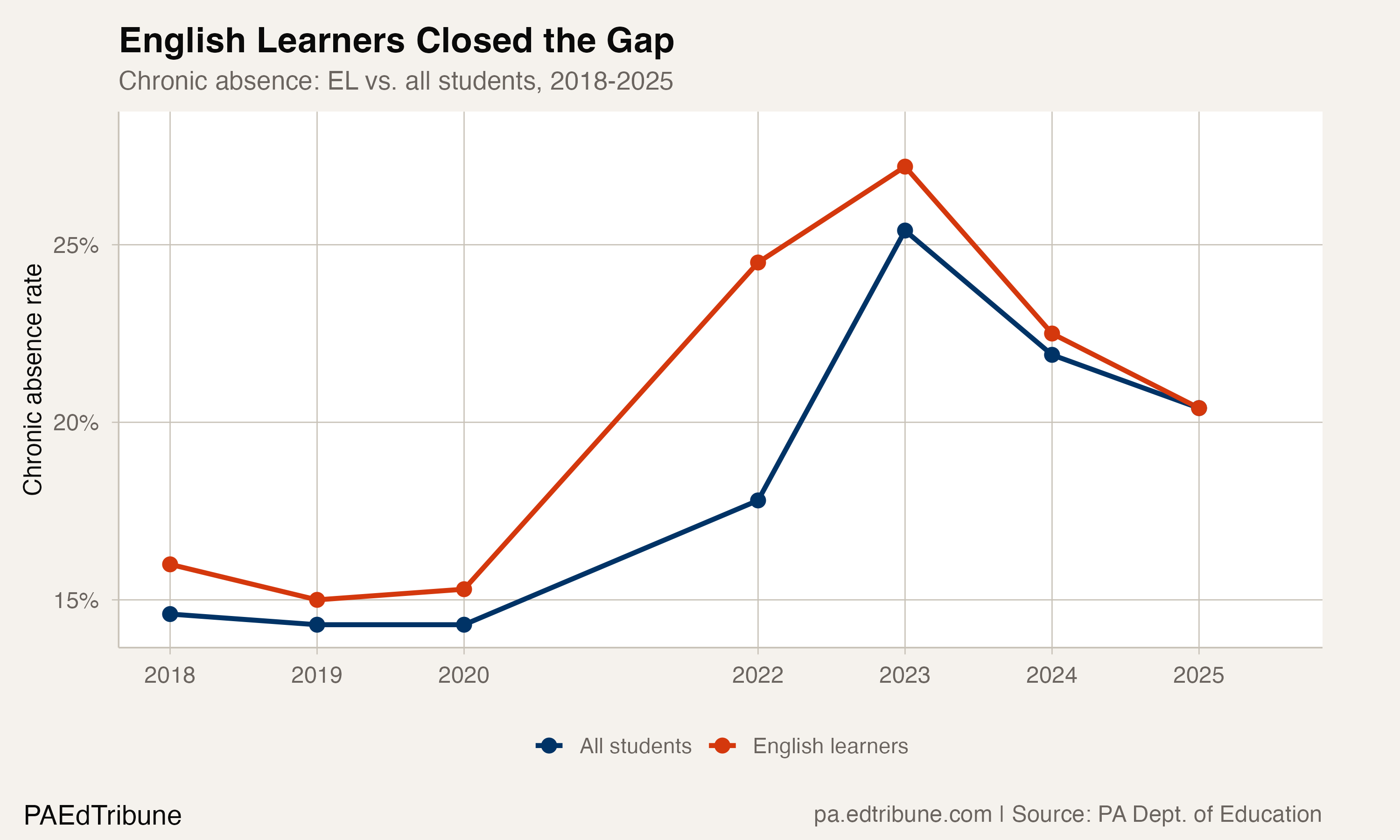
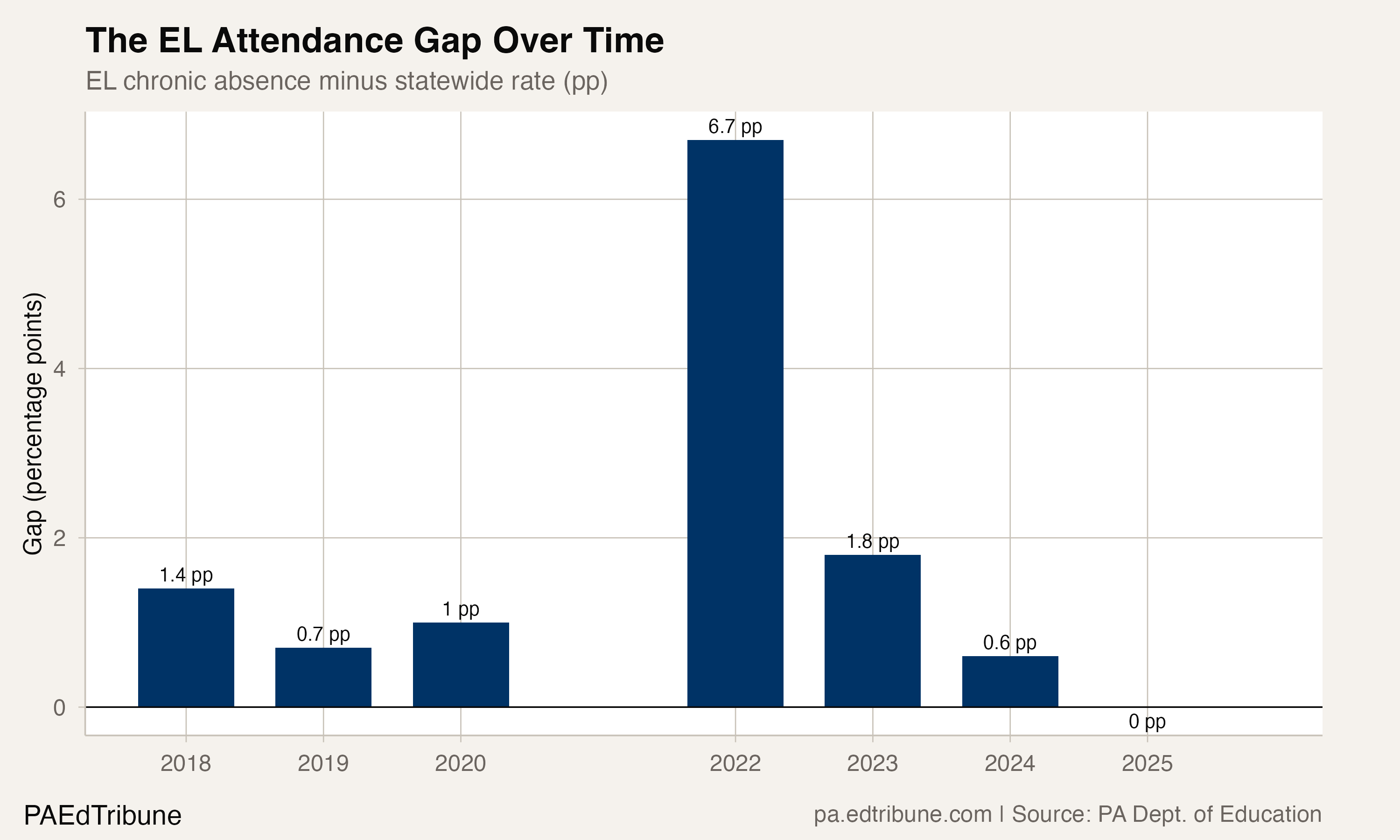
In 2018, the English learner chronic absence rate was 16.0%, 1.4 points above the state average of 14.6%. The gap was small but persistent. It narrowed to 0.7 points in 2019 and 1.0 in 2020.
COVID blew it open. In 2022, the English learner rate surged to 24.5% while the state average was 17.8%, a gap of 6.7 percentage points. English learners were not just affected by the pandemic. They were disproportionately affected, even more so than the overall population.
What followed was an unusually rapid correction. By 2023, the gap had collapsed from 6.7 to 1.8 points. By 2024, it was 0.6. In 2025, it reached zero.
The spike and the correction
The 2022 spike (24.5%, up from 15.3% pre-COVID) likely reflects the particular disruptions that immigrant and non-English-speaking families faced during the pandemic: language barriers in navigating remote schooling, job loss in service and manual labor sectors, and family instability. These are the same barriers that drive chronic absence generally, amplified by language.
The rapid correction suggests that when the acute disruptions of the pandemic receded, English learner families returned to their pre-COVID attendance patterns faster than other groups. One possible explanation: the cultural emphasis on school attendance in many immigrant communities may create a stronger rebound once barriers are removed. Another: school-based language support programs reconnected families to schools more effectively than general attendance interventions.
Pennsylvania does not publicly attribute this convergence to any specific program. No PDE press release or legislative hearing has highlighted it. The data speaks more clearly than the policy record.
Not uniform across districts
The statewide convergence masks district-level variation. Among districts with at least three schools reporting English learner data, the range in 2025 is enormous:
At the low end, West Jefferson Hills SD (2.2%), Garnet Valley SD (2.9%), and Marple Newtown SD (3.6%) have English learner chronic absence rates in the single digits. These are suburban districts where English learner populations tend to be smaller and school supports more concentrated.
At the high end, McKeesport Area SD (65.0%), Wyoming Valley West SD (50.9%), and Hazleton Area SD (41.8%) have rates above 40%. The Northeast Pennsylvania corridor, which also has elevated overall chronic absence rates, shows the same pattern for English learners specifically. Hazleton's 41.8% English learner rate reflects a district where a large and growing Hispanic population faces barriers that the overall recovery has not addressed.
What one closed gap reveals about the others
The English learner convergence inverts a common assumption. In most attendance analyses, service population gaps (poverty, disability, language) are treated as persistent and structural, harder to close than to widen. English learners in Pennsylvania broke that pattern.
The Black-white gap, by contrast, stands at 11.9 percentage points in 2025, 3.7 points wider than before COVID. The economically disadvantaged gap is 5.4 points. The special education gap is 5.7 points. None of these has closed, and between 2024 and 2025, neither the Black-white gap nor the poverty gap moved at all.
English learners closed a 6.7-point gap in three years. The Black-white gap has not moved in two. If one group can converge that fast, the persistence of other gaps is not a law of nature. It is a measure of what has been tried and what has not.
Detailed code that reproduces the analysis and figures in this article is available exclusively to EdTribune subscribers.
Discussion
Sign in to join the discussion.
Loading comments...