In 2011, barely half the students who started ninth grade in Philadelphia graduated four years later. The city's 55.2% graduation rate was the lowest of any large district in Pennsylvania and among the lowest of any major city in the country.
By 2024, that rate had reached 76.2% — a 21.1 percentage point transformation that represents the largest sustained graduation improvement of any urban district in the commonwealth.
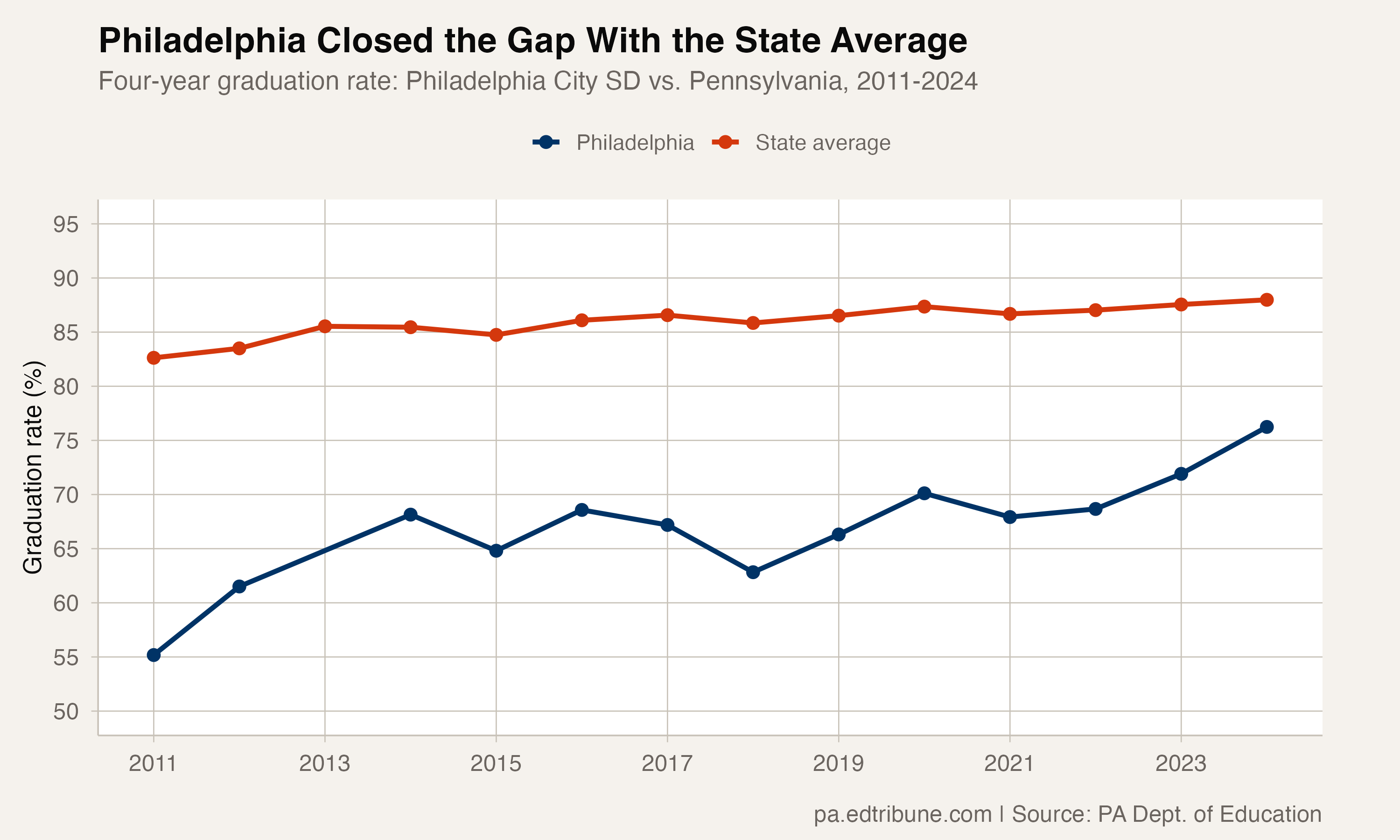
The gap between Philadelphia and the state average has not closed entirely. At 76.2%, the city still trails the state's 88.0% by nearly 12 points. But the distance has compressed from 27.4 points in 2011, and the trajectory is unmistakable: Philadelphia is converging toward the state while nearly every other struggling district in Pennsylvania has stagnated or declined.
The numbers
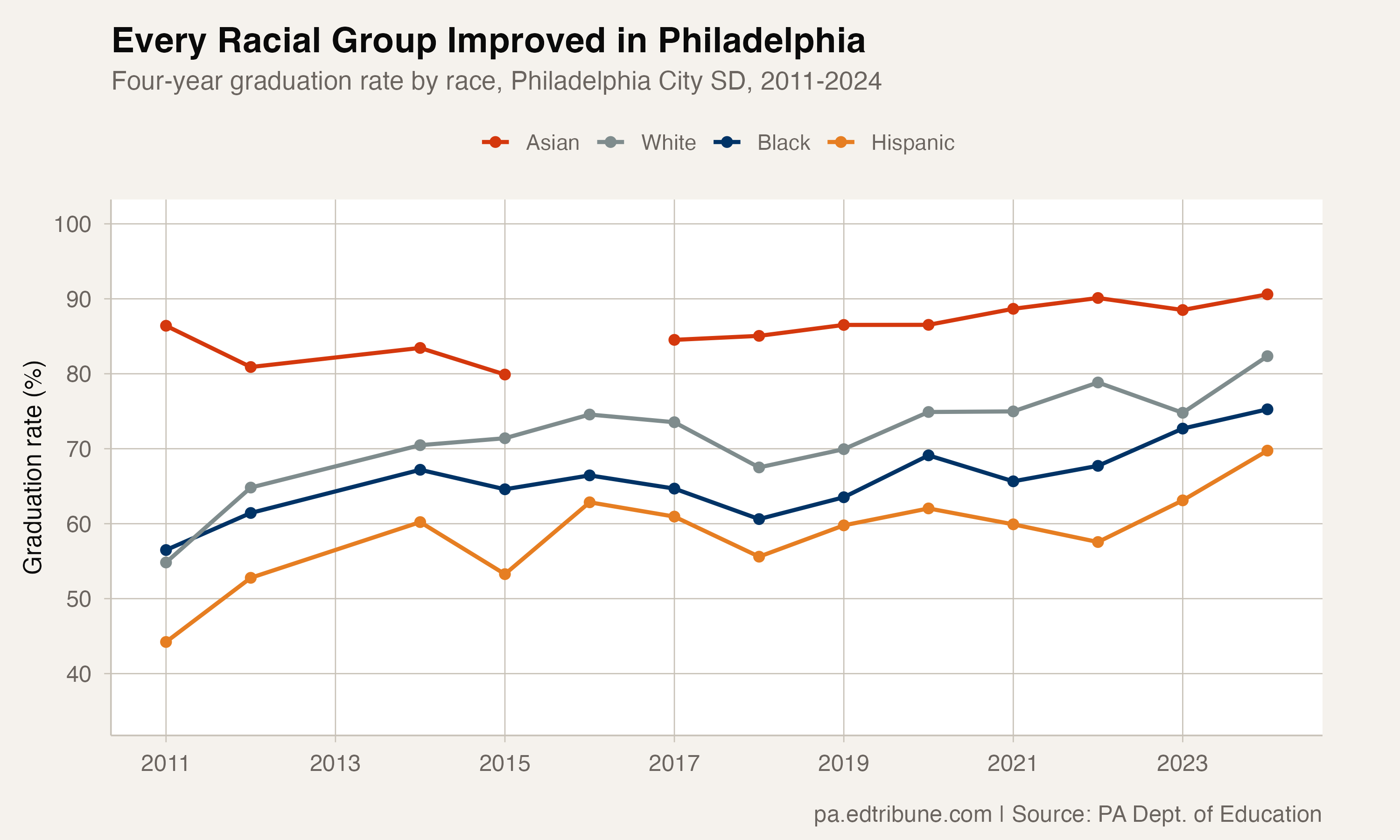
Every racial subgroup improved. Hispanic students posted the largest gain, climbing from 44.2% in 2011 to 69.7% in 2024, a 25.5 point increase. White students gained 27.5 points, reaching 82.3%. Black students, the majority of Philadelphia's cohort, gained 18.8 points to reach 75.3%. Asian students, already the highest-performing group, held steady above 86% and reached 90.6% by 2024.
The improvement was not linear. Philadelphia's rate spiked to 68.1% in 2014, fell back to 62.8% in 2018, then resumed climbing. The two most recent years (71.9% in 2023 and 76.2% in 2024) represent the fastest consecutive improvement in the entire 13-year period.
What changed: the 9th Grade Success Network
District leaders credit much of the improvement to the 9th Grade On-Track initiative, known internally as 9GOT. The program identifies freshmen at risk of falling off track (course failures, attendance, and behavioral indicators) and deploys targeted interventions before students become chronic non-completers.
The School District of Philadelphia reports that 9th-grade on-track rates for Black and Latino young men increased by 13.4 and 9.6 percentage points respectively between the 2018-19 and 2023-24 school years. The network expanded to 24 schools by 2024-25 and is targeting 32 schools by 2026-27.
The emphasis on ninth grade reflects decades of research showing that the first year of high school is the single strongest predictor of eventual graduation. Students who fail two or more courses as freshmen graduate at roughly half the rate of those who stay on track.
The asterisk
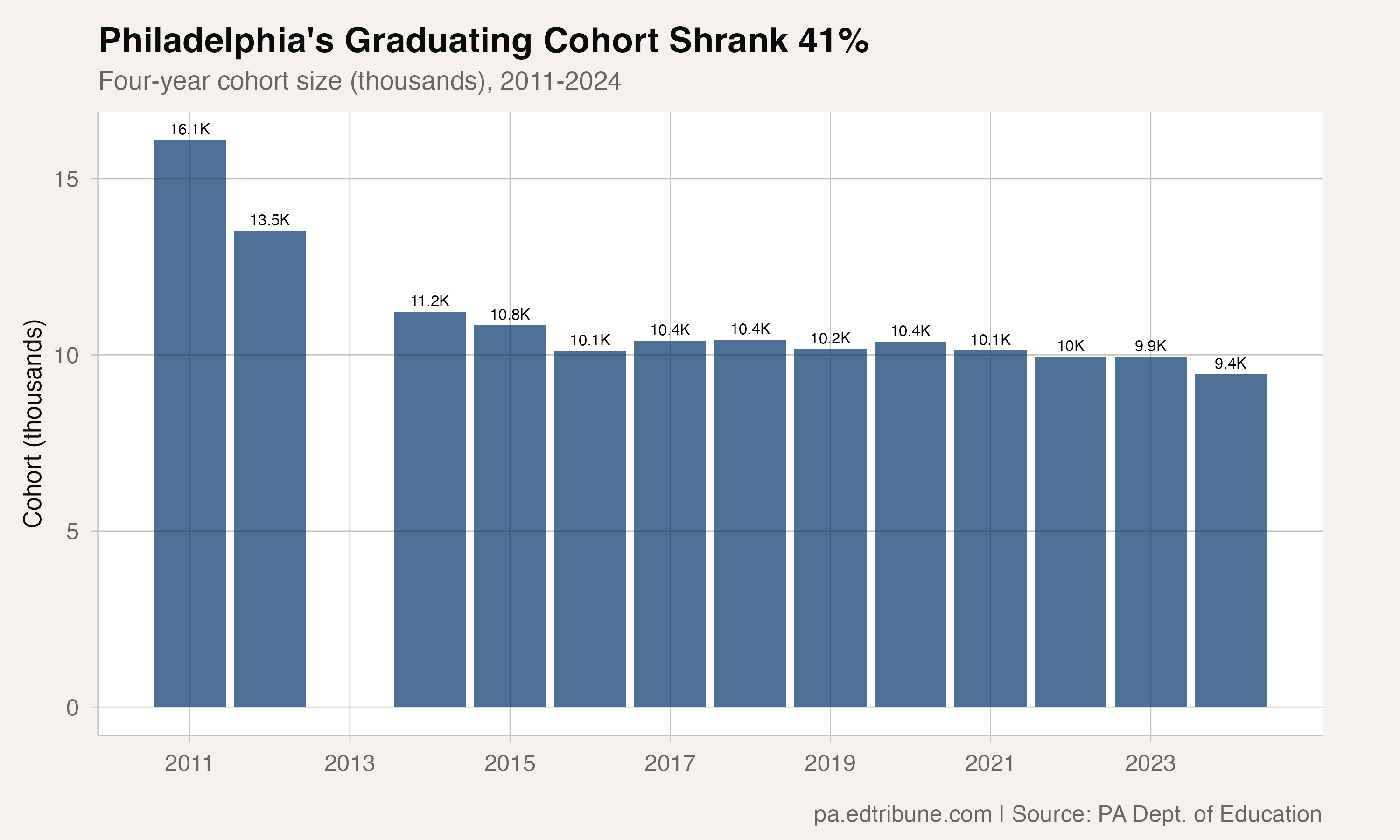
The 21-point improvement comes with a significant caveat: the graduating cohort shrank dramatically over the same period. In 2011, Philadelphia's four-year cohort included 16,099 students. By 2024, it was 9,446, a 41.3% decline that far exceeded the 10.4% cohort decline statewide.
Some of that shrinkage reflects genuine enrollment decline in a city losing population. Some reflects students transferring to charter schools, which are counted as separate districts in Pennsylvania's data. And some represents the city's growing cyber charter population — students who left Philadelphia's system but may not have left the city.
The question is whether the students who departed were disproportionately the students least likely to graduate. If so, the remaining cohort was progressively more likely to succeed regardless of interventions. A 76.2% rate for 9,446 students produces 7,198 graduates. A 55.2% rate for 16,099 students produced 8,886. The city is graduating a higher share of a much smaller group, and fewer actual graduates.
This does not negate the improvement. Even holding the cohort constant, a district cannot move from 55% to 76% through composition change alone. The 9th Grade Success Network's intervention data shows direct effects on student outcomes. But the full 21-point gain almost certainly overstates the true underlying improvement.
What it means for students
For the roughly 2,200 additional students per cohort who now graduate compared to what the 2011 rate would have predicted for today's cohort, the distinction between "genuine" and "compositional" improvement is academic. They have a diploma.
Whether that diploma translates to postsecondary success is less clear. Philadelphia's Keystone Exam proficiency rates remain far below the state average, suggesting that some graduates may be earning diplomas through alternative pathways under Act 158 without demonstrating grade-level proficiency in math and English.
The district's trajectory since 2022, gaining 7.5 points in just two years, suggests the rate may continue climbing in the near term. Whether Philadelphia can sustain that pace as it approaches 80% and runs out of easy gains will test the durability of the interventions its leaders credit.
Detailed code that reproduces the analysis and figures in this article is available exclusively to EdTribune subscribers.
Discussion
Sign in to join the discussion.
Loading comments...