In May 2025, Pennsylvania's Senate Education Committee convened a public hearing on chronic absenteeism and truancy. Testimony came from judges, school counselors, human services officials, and the Department of Education itself. The message was consistent: just 78% of the state's students attend school regularly, and the systems meant to change that are not keeping up.
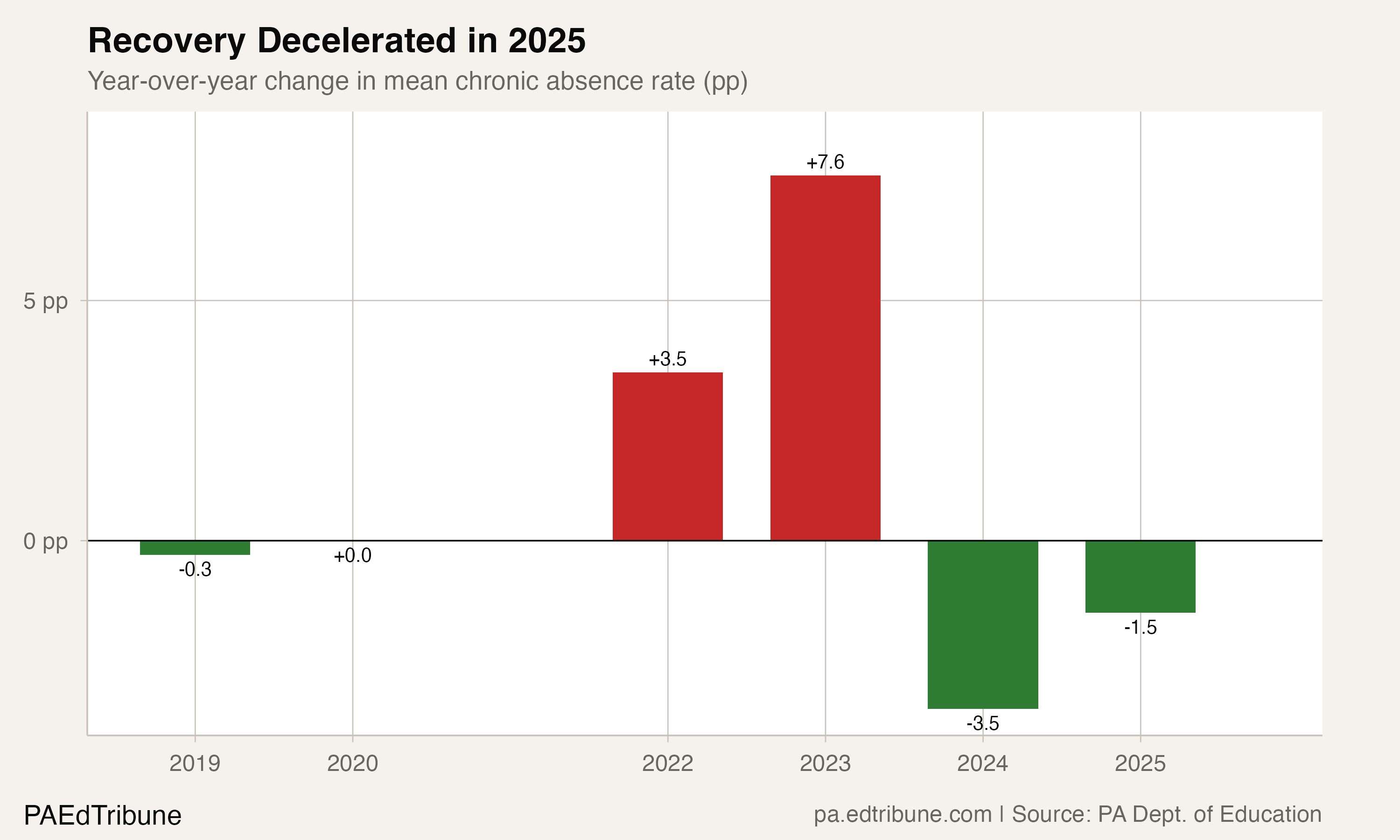
The data behind that hearing tells a sharper version of the same story. Pennsylvania's mean chronic absence rate hit 25.4% in the 2022-23 school year, nearly double its pre-COVID baseline of 14.3%. Two years of recovery have brought it down to 20.4%, but the pace of improvement is slowing. The state gained back 3.5 percentage points in 2023-24, then just 1.5 in 2024-25. At that rate, Pennsylvania will not return to pre-pandemic attendance norms until 2028 at the earliest.
The stall
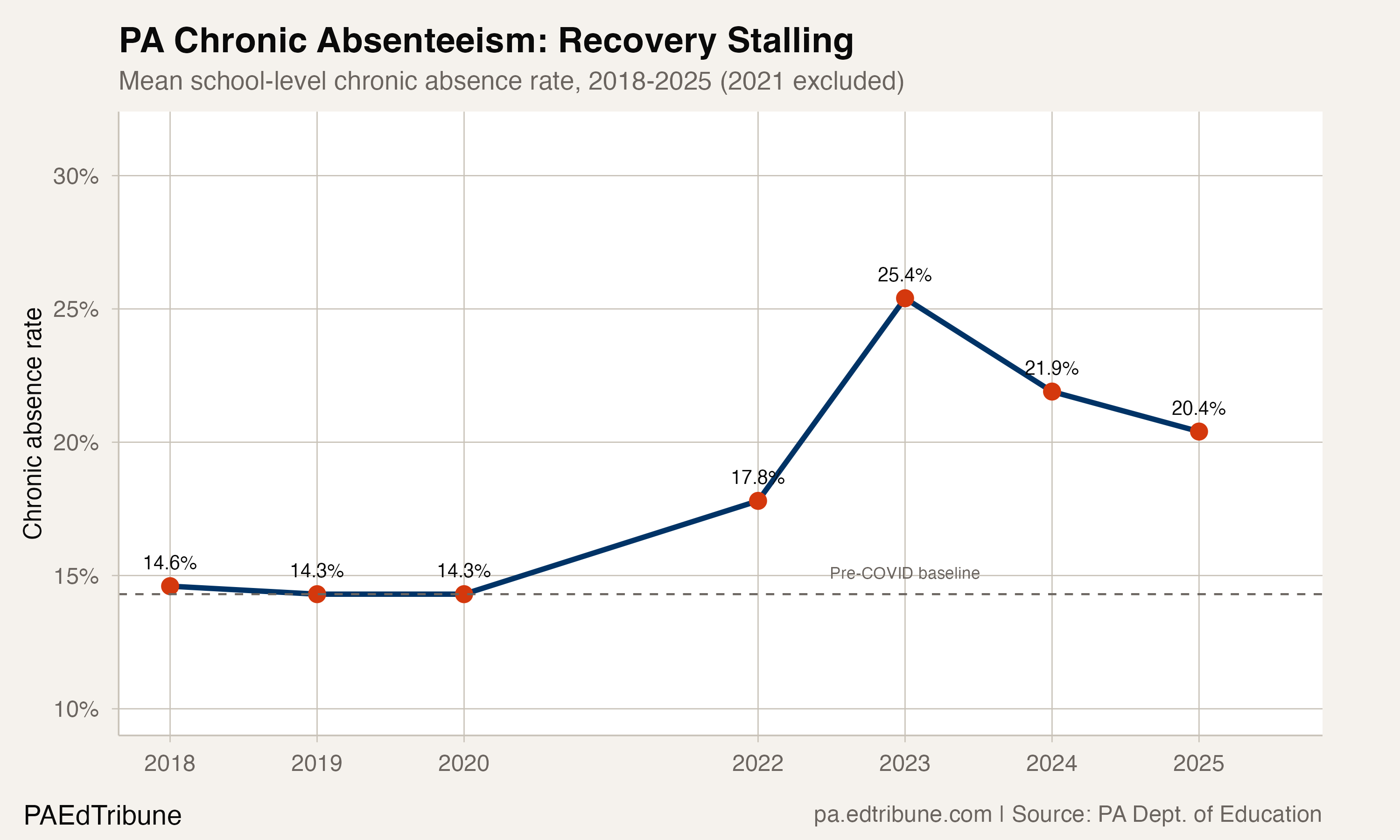
The trajectory follows a pattern visible in states nationwide: a pre-COVID baseline that held steady for years, a sharp post-pandemic spike, a partial recovery, and then a plateau. Pennsylvania's version is particularly stubborn. The state has closed just 44.9% of the gap between its 14.3% pre-COVID rate and the 25.4% peak, leaving 6.1 percentage points of excess chronic absence unresolved.
What makes the deceleration concrete: in 2023-24, the state's improvement of 3.5 percentage points meant roughly 100 fewer schools above the 50% chronic absence threshold. In 2024-25, the 1.5-point gain barely moved that number. The recovery's momentum is fading before it reaches the baseline.
Not everyone is missing school equally
The statewide average obscures a gap that has widened since COVID. Black students have the highest chronic absence rate at 28.9%, nearly three times the rate for Asian students (9.7%) and well above the white rate of 17.0%. The Black-white gap widened from 8.2 percentage points pre-COVID to 11.9 in 2024-25.
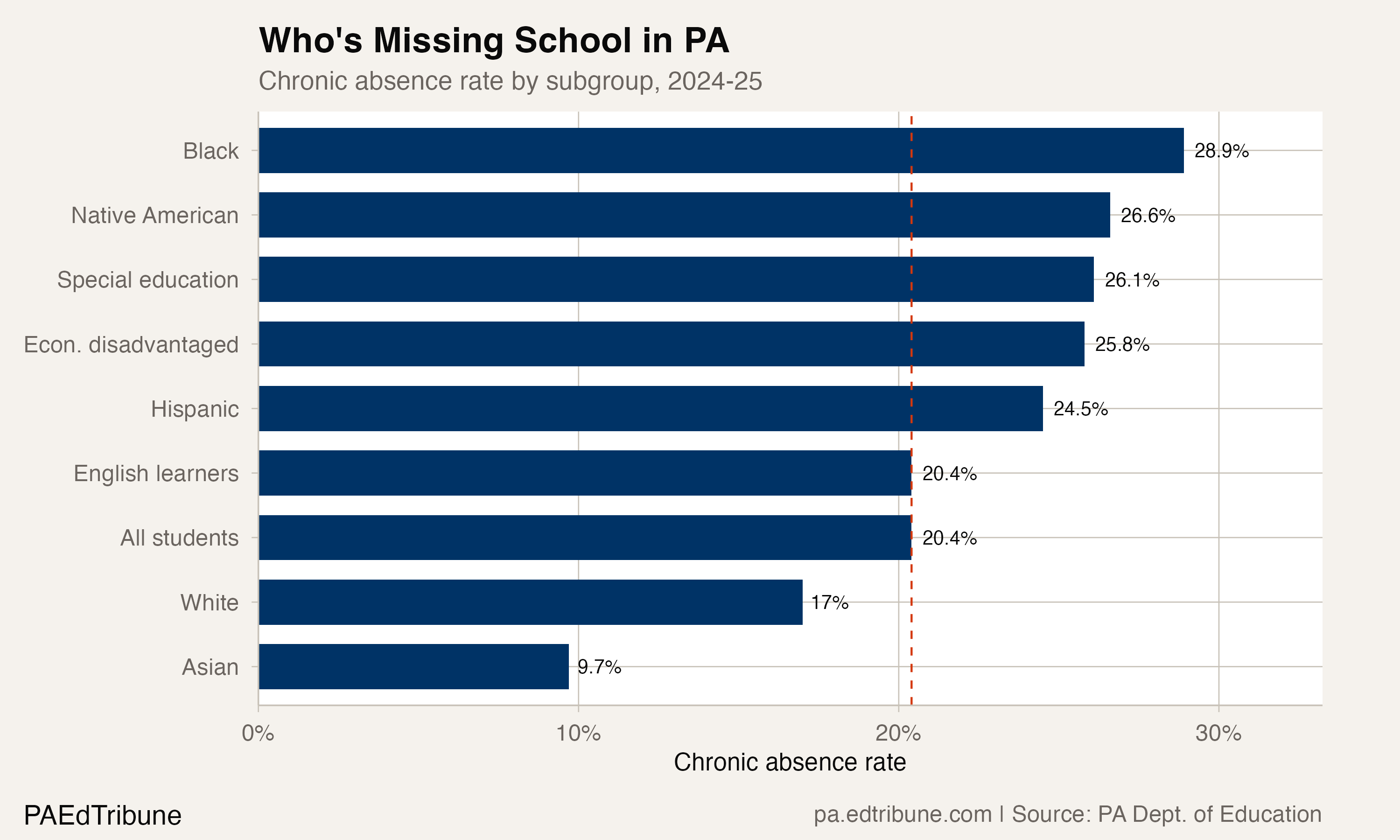
Students receiving special education services (26.1%) and economically disadvantaged students (25.8%) also exceed the statewide average by roughly 6 percentage points. These gaps predate the pandemic but are now wider than they were in 2019.
One finding breaks the pattern: English learner students have a chronic absence rate of 20.4%, exactly matching the statewide mean. Before COVID, English learners were 1.0 percentage point above the state average. That gap has closed entirely.
A state capital where half the students are missing
In Harrisburg, the state capital, chronic absence has exceeded 50% in every post-COVID year: 59.4% in 2022, 64.8% in 2023, 52.0% in 2024, and 51.1% in 2025. Even before the pandemic, Harrisburg's rate was 37.2%, more than double the statewide average. The district has improved 13.7 points from its peak, but remains above the line where more students are chronically absent than not.
Meanwhile, Greater Johnstown SD in Cambria County is moving in the wrong direction entirely: 22.8% in 2020, 41.7% in 2023, and 57.9% in 2025. While the state improved 5 points from the 2023 peak, Johnstown worsened by 16.2.
88% of districts still worse off
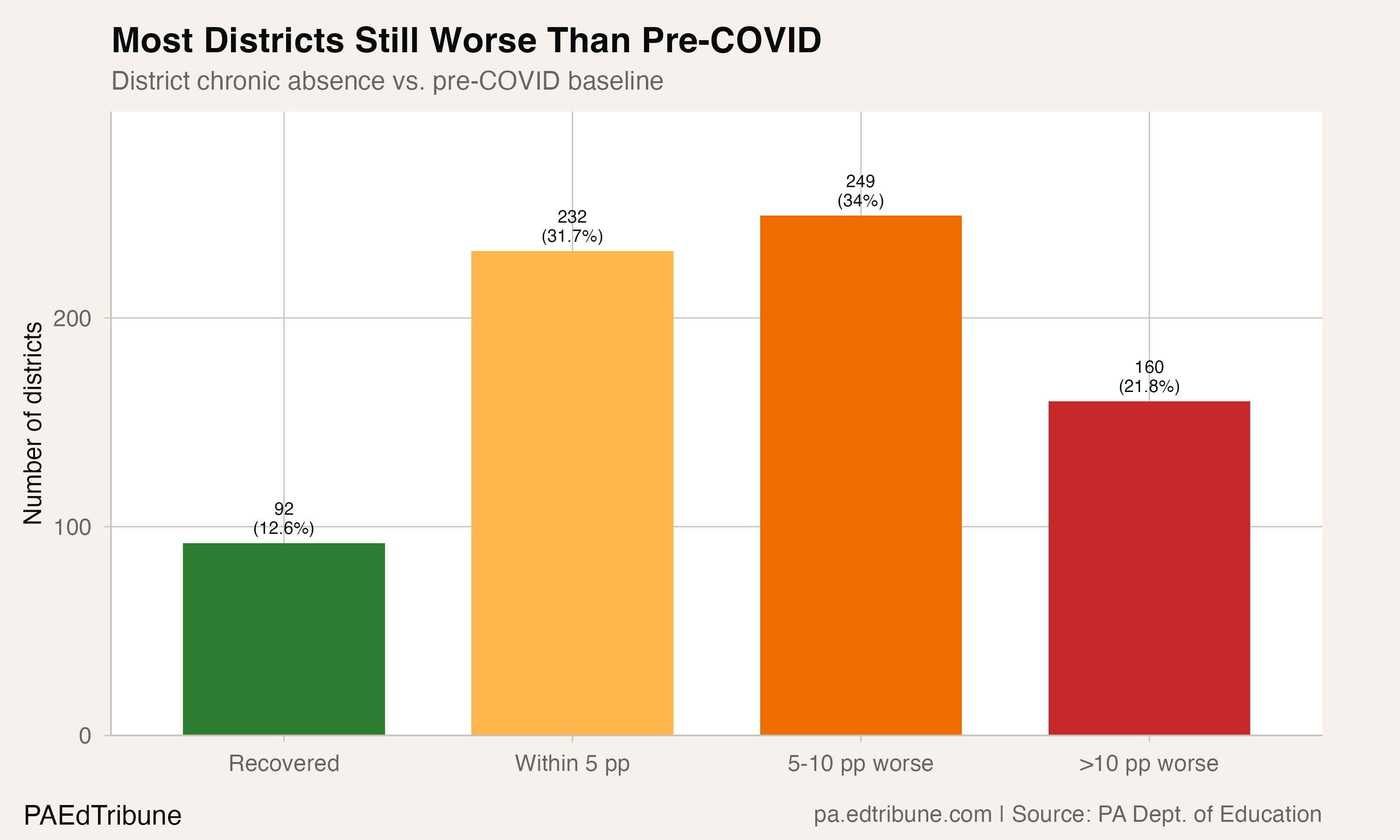
Of 733 school districts with data from both before and after COVID, only 92 (12.6%) have returned to their pre-pandemic chronic absence rates. Another 232 are within 5 percentage points of their baselines. But 409 districts, more than half, remain 5 or more points worse than before the pandemic, including 160 that are more than 10 points above their pre-COVID levels.
Barriers that go beyond school walls
"We don't have all hands on deck. We don't have everybody willing to play a role," Judge Gary Whiteman of Lycoming County told lawmakers at the May hearing. Whiteman was one of four magisterial district judges who testified, describing a truancy enforcement system that relies on fines of $300 to $750 that rarely deter the root causes of absence.
Those root causes, as identified by students and caregivers in the hearing testimony, include unreliable transportation, unmet mental health needs, food and housing instability, fear of school and community violence, and the pressure of balancing employment with school attendance. Amy Lena, the state's Deputy Secretary for Elementary and Secondary Education, acknowledged that attendance rates had not recovered and said the Department of Education was working with the Department of Human Services to develop best practices for local school districts.
What $3 billion buys, and what it does not
Governor Shapiro's administration has increased K-12 education funding by nearly $3 billion since taking office, including $111 million to sustain school-based mental health and safety services and a $526 million investment in adequacy funding for the state's most underfunded districts in the 2025-26 budget. The 2025-26 budget also reformed Pennsylvania's cyber charter reimbursement system, saving public schools $175 million.
None of this spending is specifically targeted at attendance recovery. The Senate hearing's purpose was to begin building a legislative framework, but no bills had advanced as of early 2026. The gap between funding levels and attendance outcomes reflects a structural reality: money reaches districts, but the barriers keeping students from showing up, transportation, housing, mental health, operate outside school buildings.
Samantha Murphy of Allegheny County's Department of Human Services captured the coordination problem: "We have to have these conversations together. It's great that they happen up at the top, but they have to happen locally, to actually know each other and do better."
The next year matters more than the last two
The 1.5-point improvement in 2024-25 is not zero. It is, however, less than half the gain from the year before, and the 2025-26 school year will test whether the recovery curve flattens into a new normal or continues to bend. Nationally, analysis from RAND found chronic absenteeism rates remained roughly 50% above pre-pandemic baselines into the 2024-25 school year, suggesting Pennsylvania is not alone in hitting a wall.
In Pittsburgh, where 37% of students are chronically absent, WESA reported that text-message interventions showed promise: 60% of at-risk students whose families received attendance reminders improved. That is one district, one strategy, and 733 to go. The Senate hearing produced testimony. The 2025-26 school year will show whether it produces anything else.
Detailed code that reproduces the analysis and figures in this article is available exclusively to EdTribune subscribers.
Discussion
Sign in to join the discussion.
Loading comments...