In the 2019-20 school year, Pennsylvania's cyber charter schools had a lower chronic absence rate than traditional schools: 21.7% versus 13.8%. Virtual instruction, for a subset of students who chose it, seemed to work. Then the pandemic reshuffled everything. Now the trends have crossed: traditional schools have improved to 19.9% while cyber charters have worsened to 29.7%.
The crossover
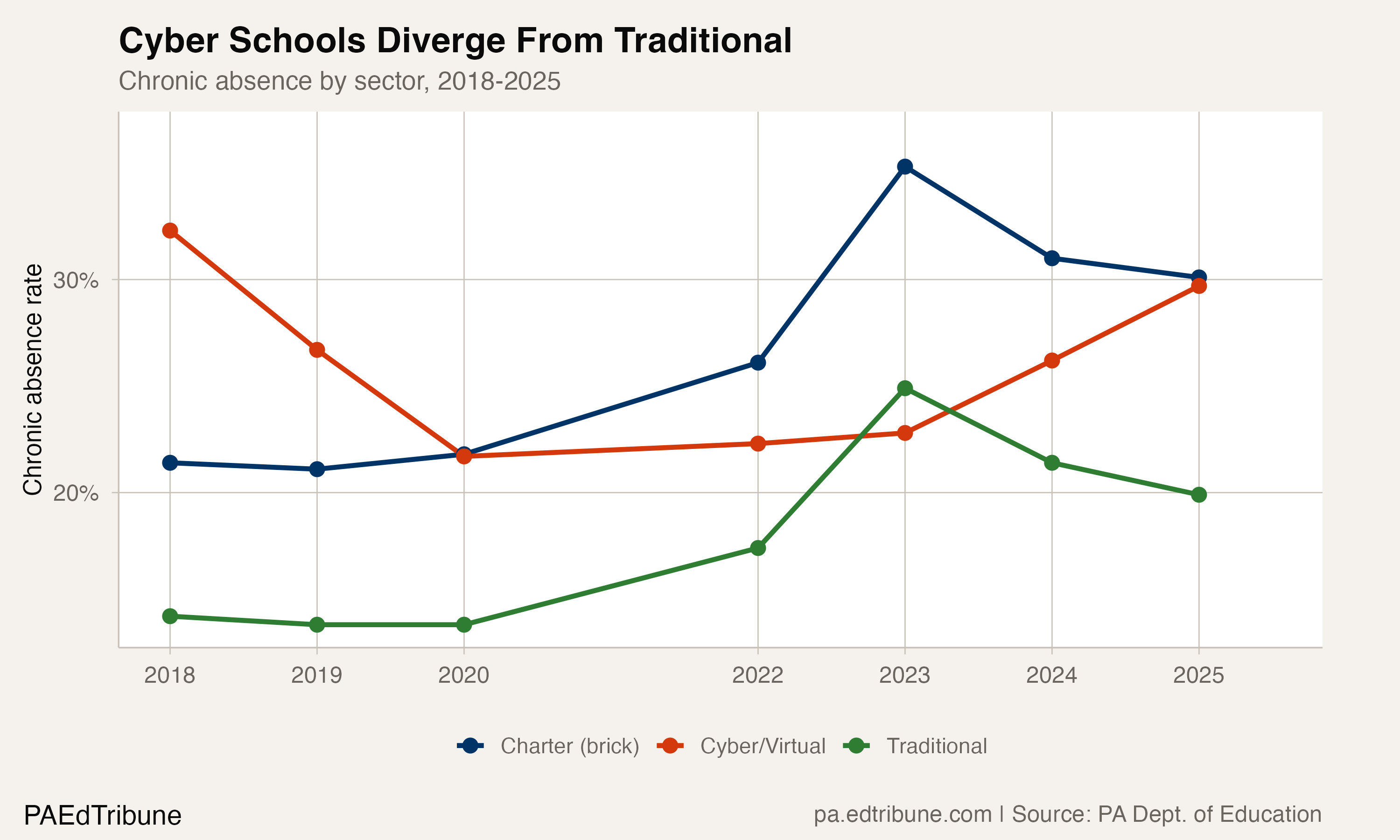
The three-sector comparison reveals different COVID trajectories. Traditional schools followed the expected arc: a baseline of roughly 14%, a spike to 24.9% in 2023, and steady recovery to 19.9% in 2025. Brick-and-mortar charter schools tracked a parallel but higher curve, rising from 21.8% to 35.3% at peak and settling at 30.1%.
Cyber charter schools took a different path entirely. Their rates were stable at 21-22% from 2020 through 2022, stayed low relative to other sectors through 2023 (22.8%), and then began climbing: 26.2% in 2024, 29.7% in 2025. As other schools recovered, cyber charters deteriorated.
The timing matters. Cyber charter chronic absence did not spike during COVID, when all schools were figuring out virtual instruction. It spiked after, when traditional schools were successfully bringing students back to buildings. The students remaining in or transferring to cyber schools in 2024 and 2025 may represent a harder-to-engage population.
Inside the worst-performing cyber schools
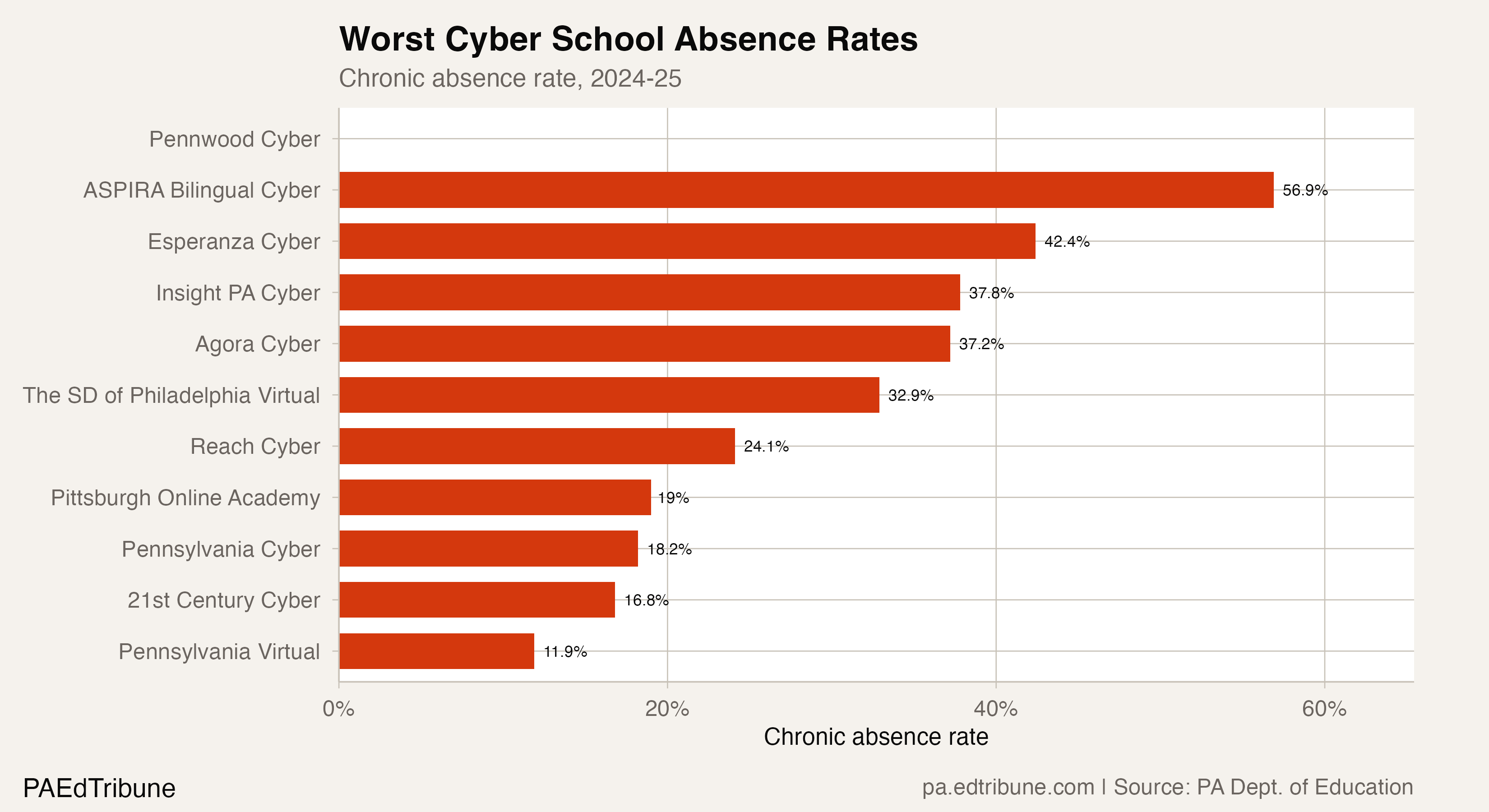
ASPIRA Bilingual Cyber CS has the highest rate at 56.9%, meaning more than half its students are chronically absent from virtual school. Esperanza Cyber CS follows at 42.4%. Insight PA (37.8%) and Agora Cyber (37.2%) round out the top four.
At the other end, Pennsylvania Virtual CS (11.9%) and 21st Century Cyber CS (16.8%) maintain rates below the statewide traditional school average. The range, from 11.9% to 56.9%, suggests that "cyber charter" is not a monolithic category. Some virtual programs maintain engagement. Others have chronic absence rates that would trigger state intervention in a brick-and-mortar school.
The reform response
Pennsylvania's 2025-26 budget included the most significant cyber charter reforms in the state's history. Among them: students with regular unexcused absences can no longer transfer to a cyber charter during the academic year without judicial approval. Cyber charters must now conduct mandatory weekly wellness checks on students. Students must be visible on webcam during live instruction to be marked present. And for asynchronous learning, schools must set weekly academic benchmarks and can mark students absent for failing to meet them.
The reforms also reconfigured the tuition formula, which the Department of Education estimates will save traditional districts $178 million annually. The financial incentive to enroll students in cyber charters regardless of engagement has been one of the system's structural flaws. A Chalkbeat analysis found the broader reform package could save public schools $616 million.
What attendance means in a virtual school
Chronic absence in a virtual school raises definitional questions that brick-and-mortar schools do not face. When a student is "absent" from a cyber charter, they are absent from logging in, from completing assignments, from appearing on camera. Whether they are disengaged, or whether the measurement itself is inconsistent, depends on how each cyber charter defines and tracks participation.
The new webcam and benchmark requirements began changing what counts as attendance in cyber charters in 2025-26. It is possible that chronic absence rates in this sector will rise further as definitions tighten, before any behavioral improvement shows up in the numbers. It is also possible that the reforms will push chronically absent students back to traditional schools, shifting the attendance burden rather than solving it.
Pennsylvania's authorized cyber charter sector includes more than a dozen schools enrolling tens of thousands of students. The new webcam requirements and weekly benchmarks took effect during 2025-26. The next round of data will be the first to reflect a cyber charter sector operating under those attendance rules.
Detailed code that reproduces the analysis and figures in this article is available exclusively to EdTribune subscribers.
Discussion
Sign in to join the discussion.
Loading comments...