Correction: An earlier version of this article reported that 37% of Pittsburgh students were chronically absent and estimated 7,400 students missing 18 or more days. The district's average across its schools is 33% (a simple mean of 32.7%, consistent with the figures used throughout this piece), and the corresponding count is an estimated 6,400 students. The state has since republished Pittsburgh's 2025-26 school-level file with 57 schools (up from 56), which is reflected in the school count and the enrollment-based estimate.
Pittsburgh's chronic absence rate was worsening before COVID. It was 24.0% in 2018, 25.4% in 2019, and 26.6% in 2020. That steady escalator, roughly 1.3 percentage points per year, was already a problem. The pandemic simply accelerated the trajectory: 28.8% in 2022, 42.1% in 2023. Two years of recovery have brought it to 32.7%. But 32.7% is still higher than any pre-COVID year, and the rate fell just 1.8 points from 2024 to 2025.
Pittsburgh's attendance problem did not start with COVID. COVID just made it impossible to ignore.
A pre-existing condition
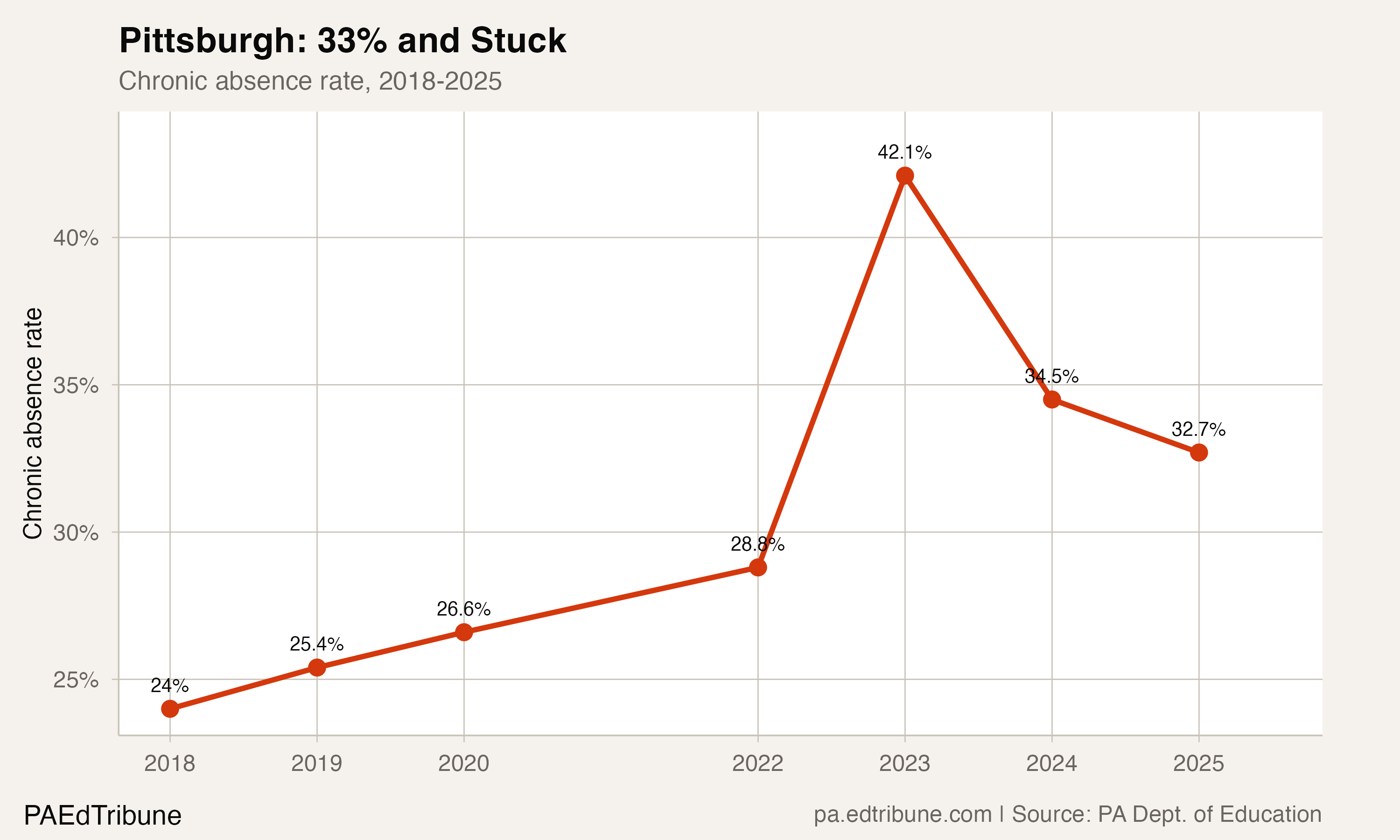
The trajectory distinguishes Pittsburgh from most Pennsylvania districts. Statewide, chronic absence was stable or slightly declining before COVID (14.6% in 2018, 14.3% in 2020). The pandemic spike was an aberration from a steady baseline. For Pittsburgh, there was no steady baseline. The district was already on an upward trend, gaining 2.6 percentage points in the two years before the pandemic.
That pre-existing trajectory makes recovery harder. Even if Pittsburgh recovers from the COVID spike, it returns to a rate that was already climbing. The district would need to not only undo the pandemic's impact but reverse the trend that preceded it.
The racial dimension
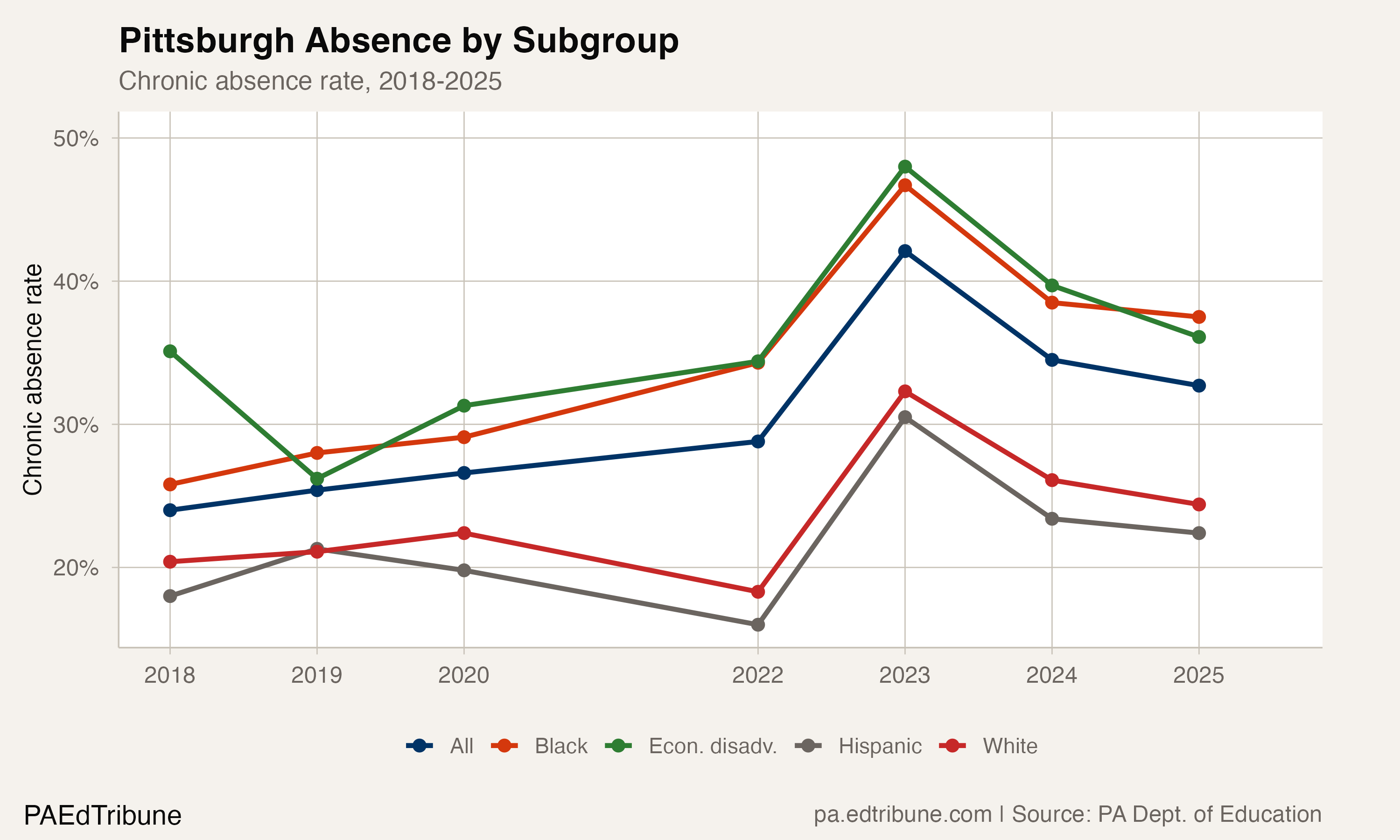
Pittsburgh's Black students have a chronic absence rate of 37.5%, 13.1 points above the white rate of 24.4%. Students who are economically disadvantaged are at 36.1%. These gaps widened during COVID. In 2018, the Black-white gap was 5.4 points (25.8% vs. 20.4%). By 2022, it was 16.0 points (34.3% vs. 18.3%). It has narrowed to 13.1 in 2025 but remains well above its pre-COVID level.
Hispanic students in Pittsburgh tell a different story. Their rate is 22.4%, the lowest of any racial group and 10.3 points below the overall district average. This is unusual nationally, as Hispanic students in most states have higher chronic absence rates than white students. In Pittsburgh, Hispanic chronic absence actually fell during the pandemic year (19.8% in 2020 to 16.0% in 2022) before rising again.
Text messages and what works
WESA reported that Pittsburgh's chronic absenteeism rate actually increased from 32% to 34% between 2023-24 and 2024-25 at the district level, and that efforts to reduce absenteeism had "reversed course." The same reporting found that text-message interventions showed promise: 60% of at-risk students whose families received attendance reminders improved their attendance.
The text-message finding matters because it suggests that for a subset of students who are chronically absent, the barrier is not structural (transportation, housing, safety) but informational. Families may not realize their child has crossed the chronic absence threshold, or the reminder may be enough to shift behavior on the margin. For the other 40%, the barriers run deeper.
Across Pittsburgh's 57 schools, the average chronic absence rate is 33%. Applied to the roughly 20,000 students enrolled in the district's traditional schools, that works out to an estimated 6,400 students missing 18 or more days per year. (The state's school-level data does not publish student counts, so this is an estimate from the rate, not a reported figure.) The scale of the problem exceeds what text messages alone can address. But the 60% response rate is one of the more concrete data points in a policy area where evidence is thin.
Where Pittsburgh stands among peers
Among Pennsylvania's large urban districts, Pittsburgh's 32.7% rate places it in the middle of the pack. Philadelphia (38.9%), Harrisburg (48.4%), and Scranton (50.5%) are worse. Reading (28.4%) and Allentown (data available at school level) are better. Nationally, the RAND Corporation found that in roughly half of urban school districts, more than 30% of students were chronically absent in 2024-25.
Pittsburgh is average among urban districts, which is not a reassuring benchmark. The district's budget faces its own pressures, and the end of federal pandemic relief funding in 2024 removed a source of money that some districts used for attendance outreach. The text messages reached 60% of at-risk families. The federal money is gone. Pittsburgh's rate was climbing before COVID, and the pandemic just steepened the slope. Getting below 30% would mean reaching a level the district has not seen since 2020, and even then, it was heading in the wrong direction.
Detailed code that reproduces the analysis and figures in this article is available exclusively to EdTribune subscribers.
Discussion
Sign in to join the discussion.
Loading comments...