Greater Johnstown SD sits in Cambria County, a former steel center where the population has been declining since the 1920 census. Its chronic absence rate was 27.8% before COVID. In 2024-25, it is 57.8%, the highest of any multi-school district in the state. While the rest of Pennsylvania improved from the 2023 peak, Johnstown worsened by 16 points.
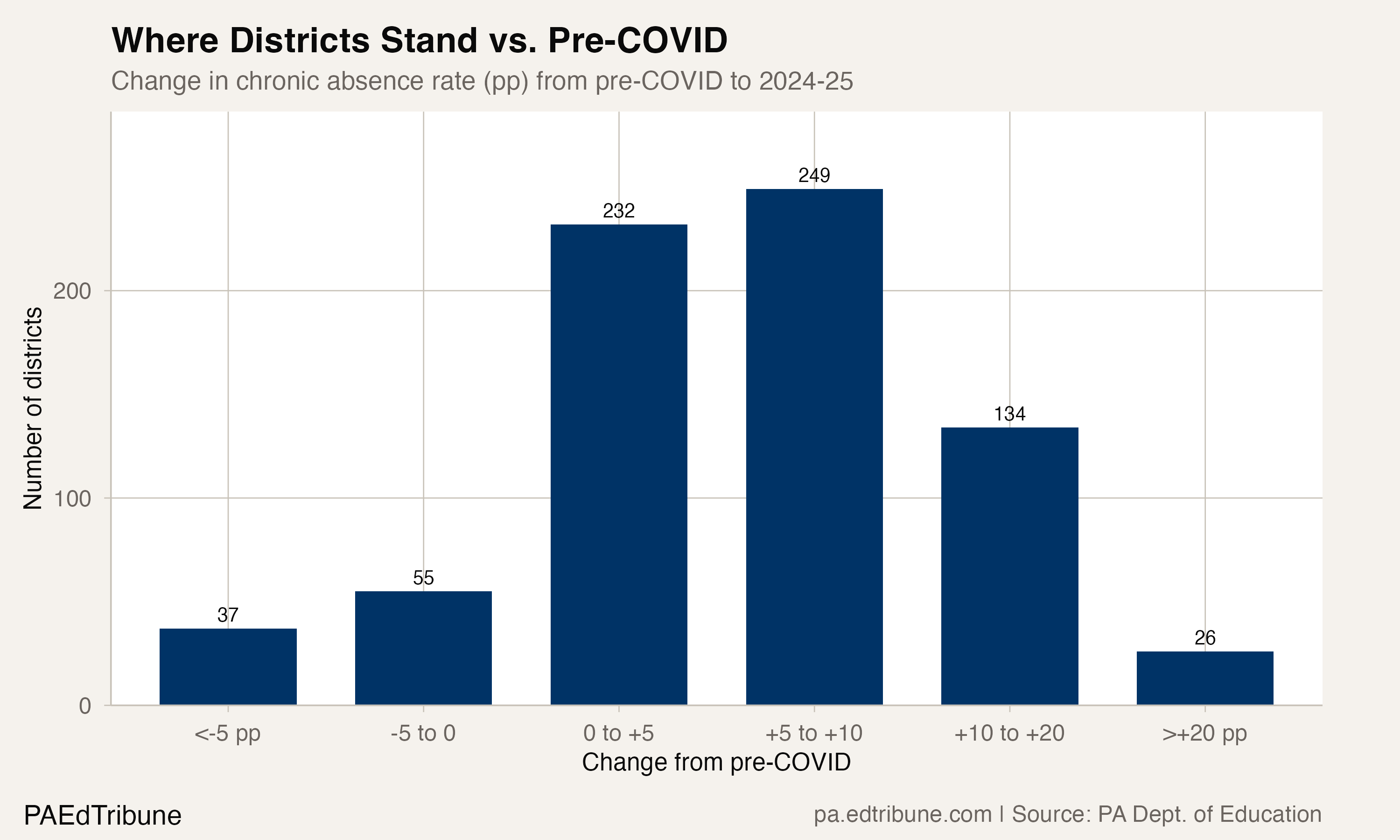
Johnstown is an outlier in magnitude but not in direction. Of 733 Pennsylvania school districts with chronic absence data from both before and after the pandemic, just 92 have returned to their pre-COVID rates. That is 12.6%.
The landscape of non-recovery
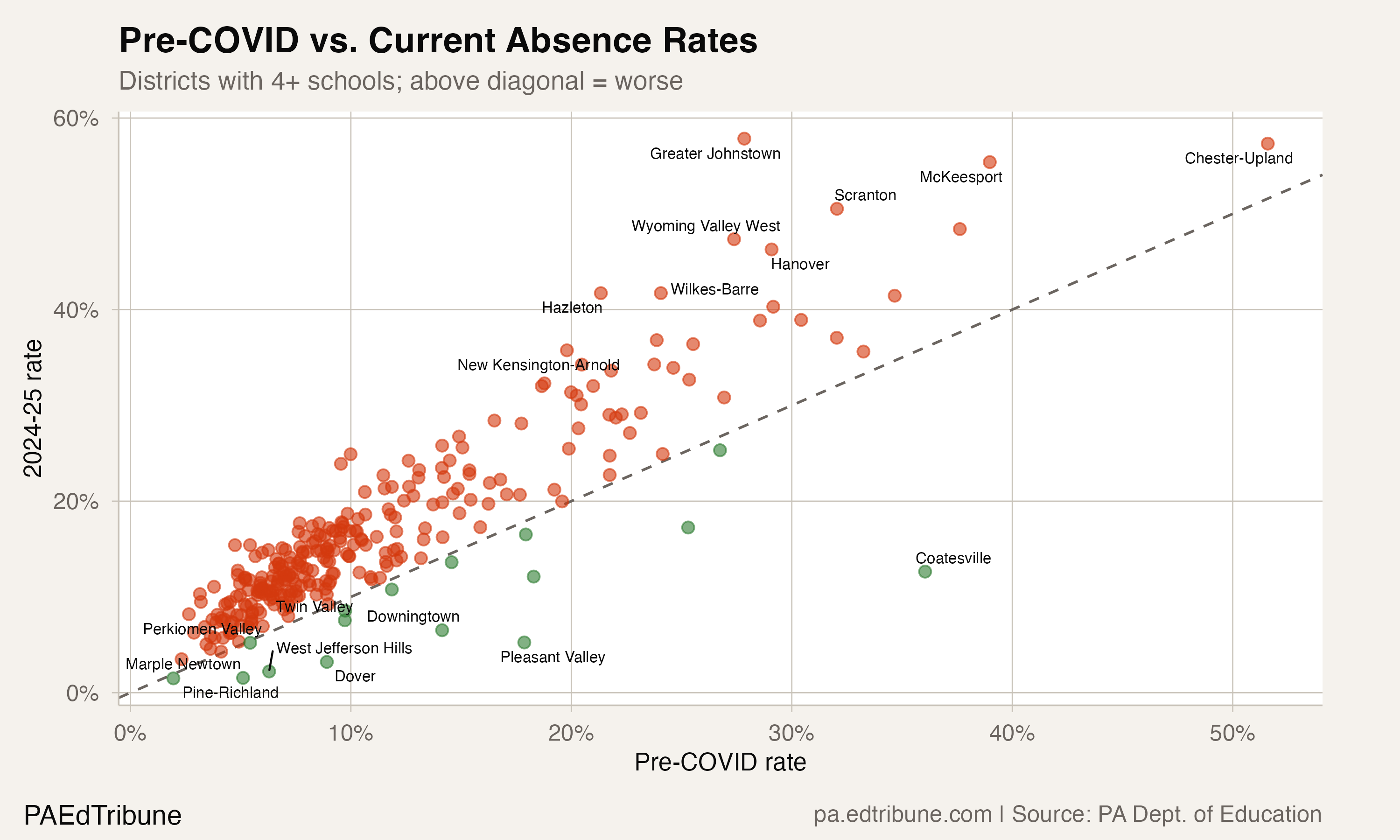
The scatter plot tells the story without narration. The diagonal line represents no change: districts above it are worse than before COVID. Nearly every dot sits above the line. The few that fall below, districts like Coatesville Area SD (from 36.0% to 12.6%, a 23.4-point drop) and Pleasant Valley SD (from 17.9% to 5.3%), are so rare they stand out visually.
The pattern holds across district types. Small suburban districts that had rates of 5% before COVID now sit at 8% or 9%. Mid-size urban districts that were at 25% are now above 35%. The pandemic did not rearrange the hierarchy of attendance. It lifted every district's chronic absence rate by roughly 6 points and then set them back down, slightly lower, but still elevated.
The districts that never came back
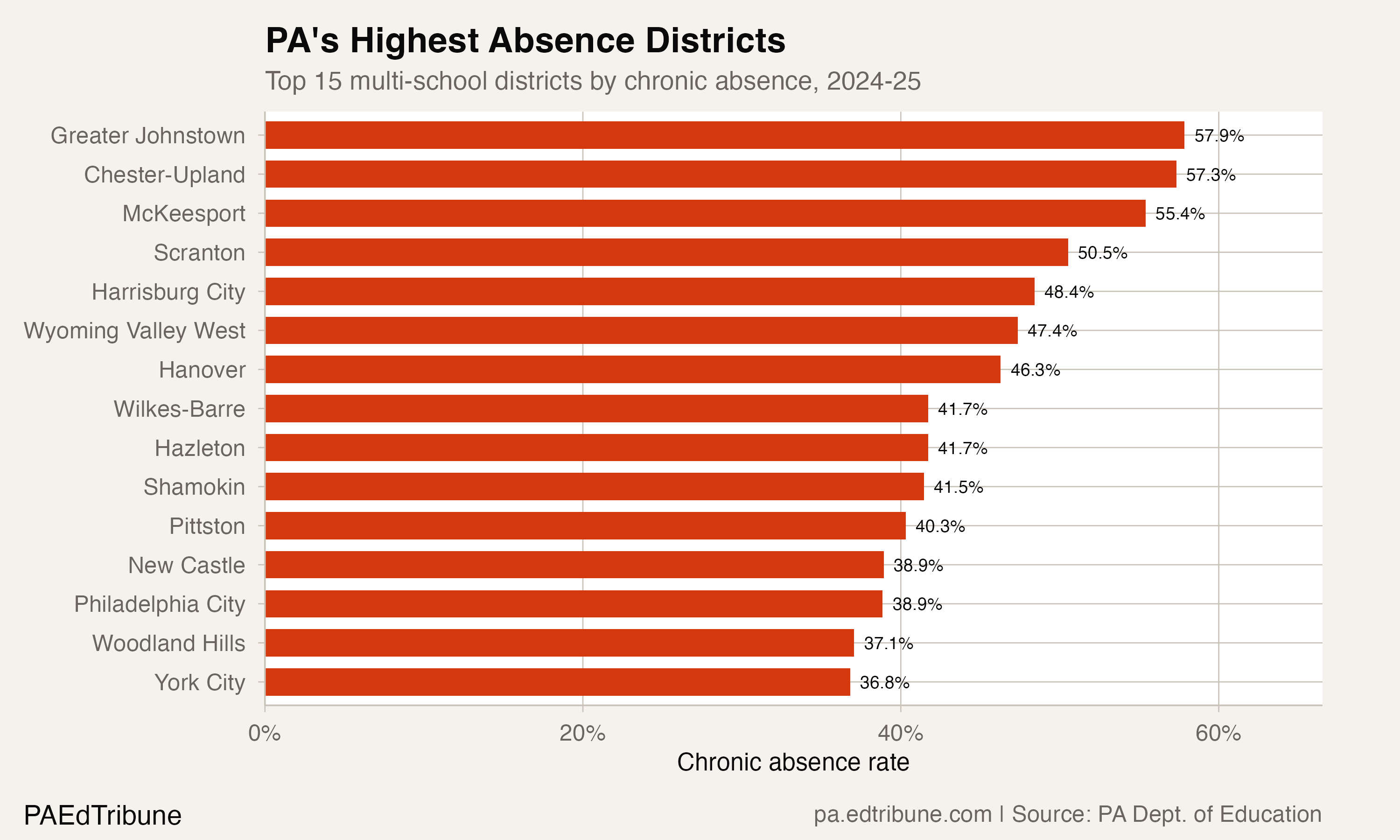
Seven multi-school districts now have chronic absence rates above 50%, meaning more students are chronically absent than not. Greater Johnstown (57.8%), Chester-Upland (57.3%), and McKeesport (55.4%) lead the list. Chester-Upland, a district under state financial receivership in Delaware County, has never recorded a rate below 50% in the seven years of available data.
The Northeast Pennsylvania corridor stands out. Wyoming Valley West (47.4%), Hanover Area (46.3%), Wilkes-Barre Area (41.7%), and Hazleton Area (41.7%) are all in the 40s, forming a geographic cluster of elevated absence in Luzerne County. Hazleton's rate more than doubled from its pre-COVID level of 21.3%.
Scranton SD, despite its size (15 schools), sits at 50.5%. Governor Shapiro visited Scranton schools in 2025 to highlight K-12 investments, but the district's chronic absence rate has risen 18.5 points since before the pandemic.
The exceptions
Coatesville Area SD's trajectory is the sharpest reversal in the state. The Chester County district went from a 36.0% pre-COVID average to a peak of 50.1% in 2022, then dropped to 12.6% by 2025, a 37.5-point improvement. The decline happened across all subgroups simultaneously, suggesting a systemic intervention rather than compositional change.
Downingtown Area SD (14.1% to 6.5%), Dover Area SD (8.9% to 3.2%), and Pine-Richland SD (5.1% to 1.6%) also improved past their pre-COVID baselines. These districts tend to be suburban, moderately affluent, and small enough that attendance interventions can reach families directly. Scaling what worked in a 6-school district to a 15-school one is a different problem.
147 schools where the majority is absent
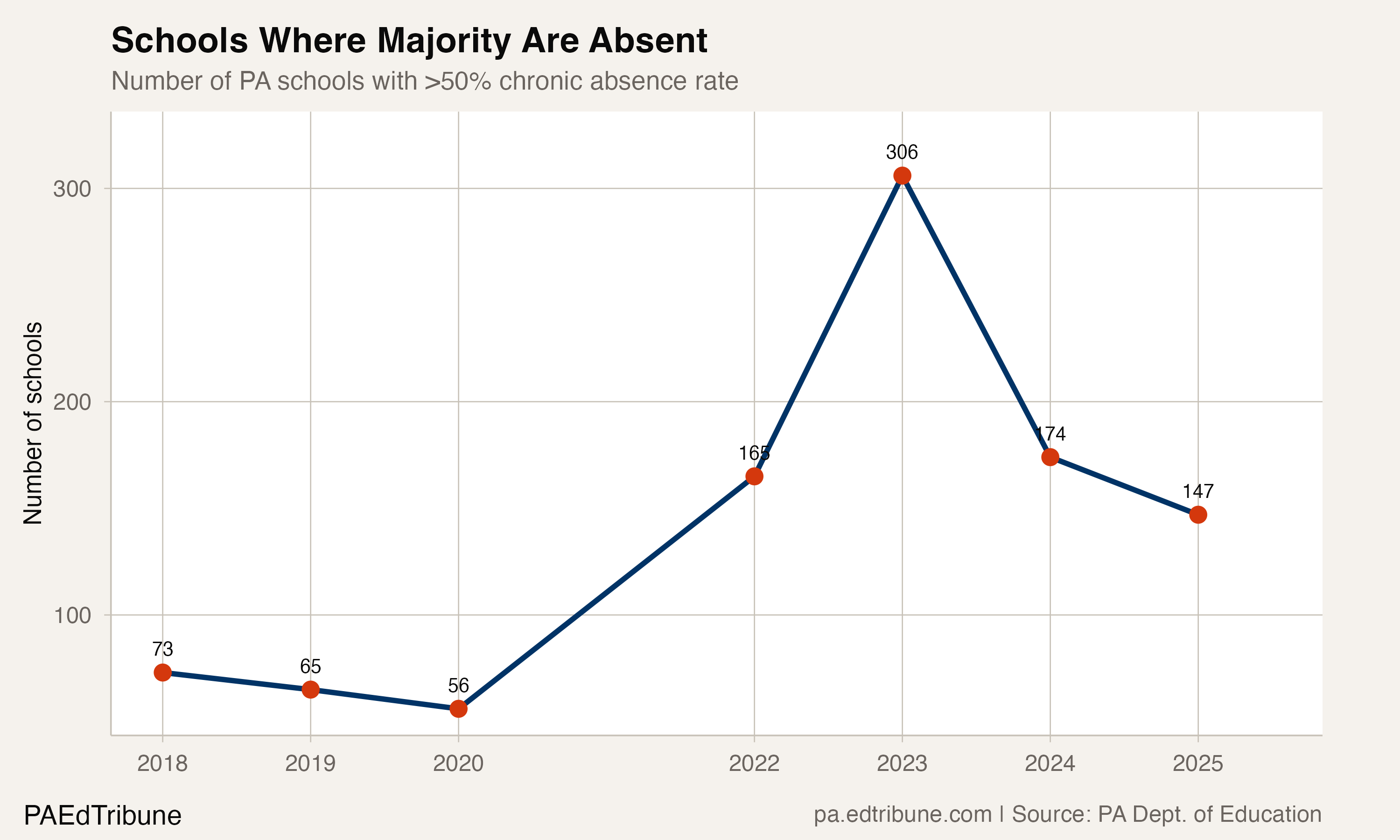
Before COVID, 56 individual Pennsylvania schools had chronic absence rates above 50%. In 2023, that number surged to 306. It has come down to 147 in 2024-25, but that is still nearly triple the pre-pandemic count.
The 583 schools (20% of all schools) with rates above 30% represent a larger structural problem. These are not exclusively urban: they include cyber charter schools, alternative programs, and traditional schools in small towns where a single factory closure or housing development can shift attendance patterns.
What recovery actually requires
The American Enterprise Institute's Nat Malkus, who testified before the Pennsylvania Senate Education Committee in May 2025, has documented that national progress on absenteeism stalled in the most recent school year, with the average chronic absenteeism rate settling at roughly 50% above pre-pandemic baselines. Pennsylvania's 44.9% recovery rate (closing 5.0 of 11.1 excess percentage points) places it squarely in that national pattern.
The 641 districts that have not recovered are not all failing equally. Some are within a few percentage points of their baselines and may close the gap with continued improvement. Others, like Johnstown and Chester-Upland, are farther from their pre-COVID rates than they were at any point during the pandemic itself. The Senate hearing was in May 2025. As of early 2026, no legislation has advanced. The 641 non-recovered districts are not waiting for a bill. They are waiting for something that works in their buildings, with their students, on their budgets.
Detailed code that reproduces the analysis and figures in this article is available exclusively to EdTribune subscribers.
Discussion
Sign in to join the discussion.
Loading comments...