Chester-Upland↗ET SD has been in state financial receivership since 2012. Three successive court-appointed receivers have tried to stabilize a district where teachers once voted to work without pay because the district could not make payroll, where nearly half the students attend charter schools, and where the state auditor general declared the district in "administrative chaos".
Through all of that upheaval, one number has not changed: the chronic absence rate has never dropped below 50%.
Seven years, seven data points, same story
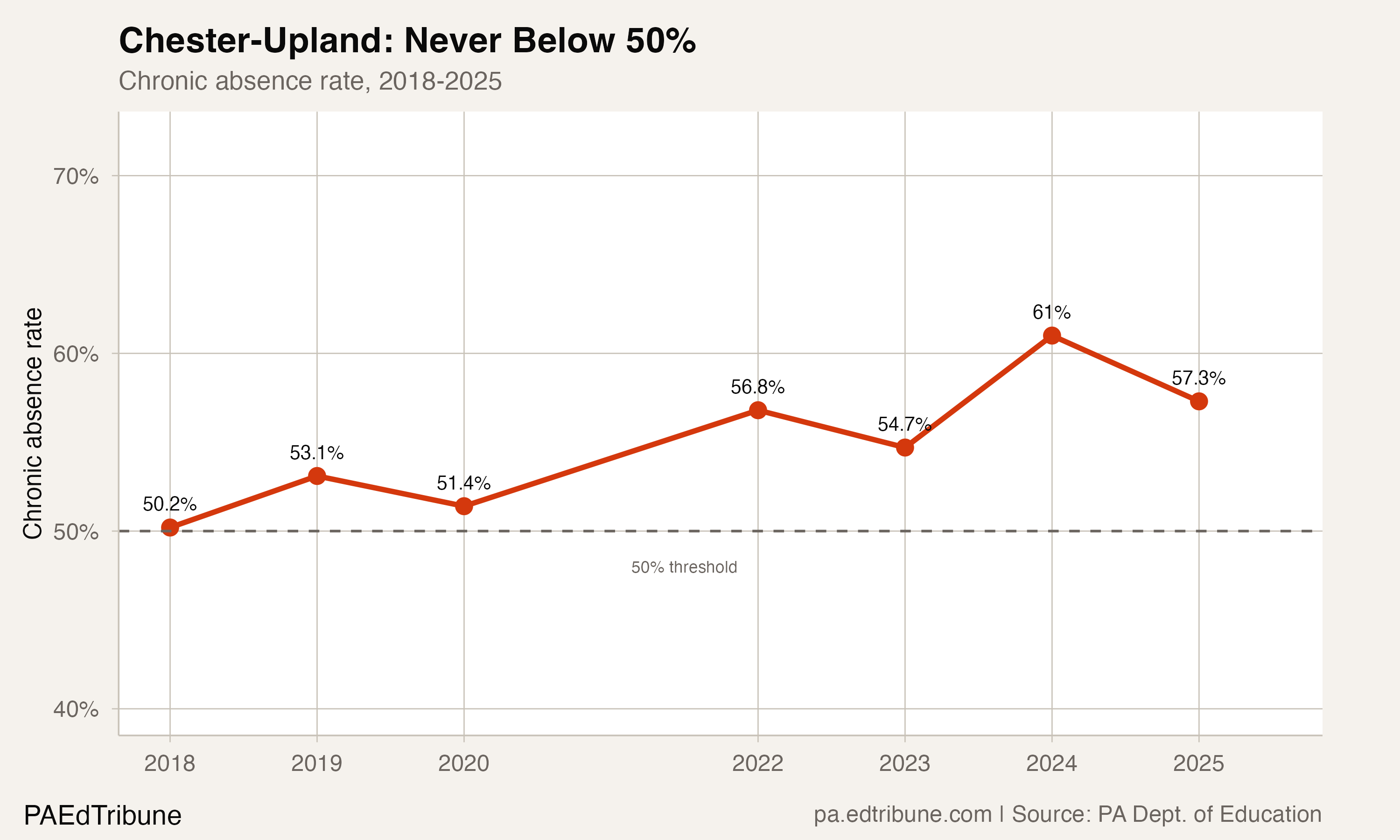
In 2018, Chester-Upland's chronic absence rate was 50.2%. In 2025, it is 57.3%. The highest point was 61.0% in 2024. The lowest was 50.2% in 2018. Every data point in between falls in the 50s. There is no recovery trajectory. There is no pre-COVID baseline to return to, because even before the pandemic, a majority of the district's students were chronically absent.
Across seven schools in 2025, the district's 57.3% rate means that for every student who attends school regularly, roughly 1.3 do not. The rate is nearly triple the statewide average of 20.4%.
A contrast in crisis response
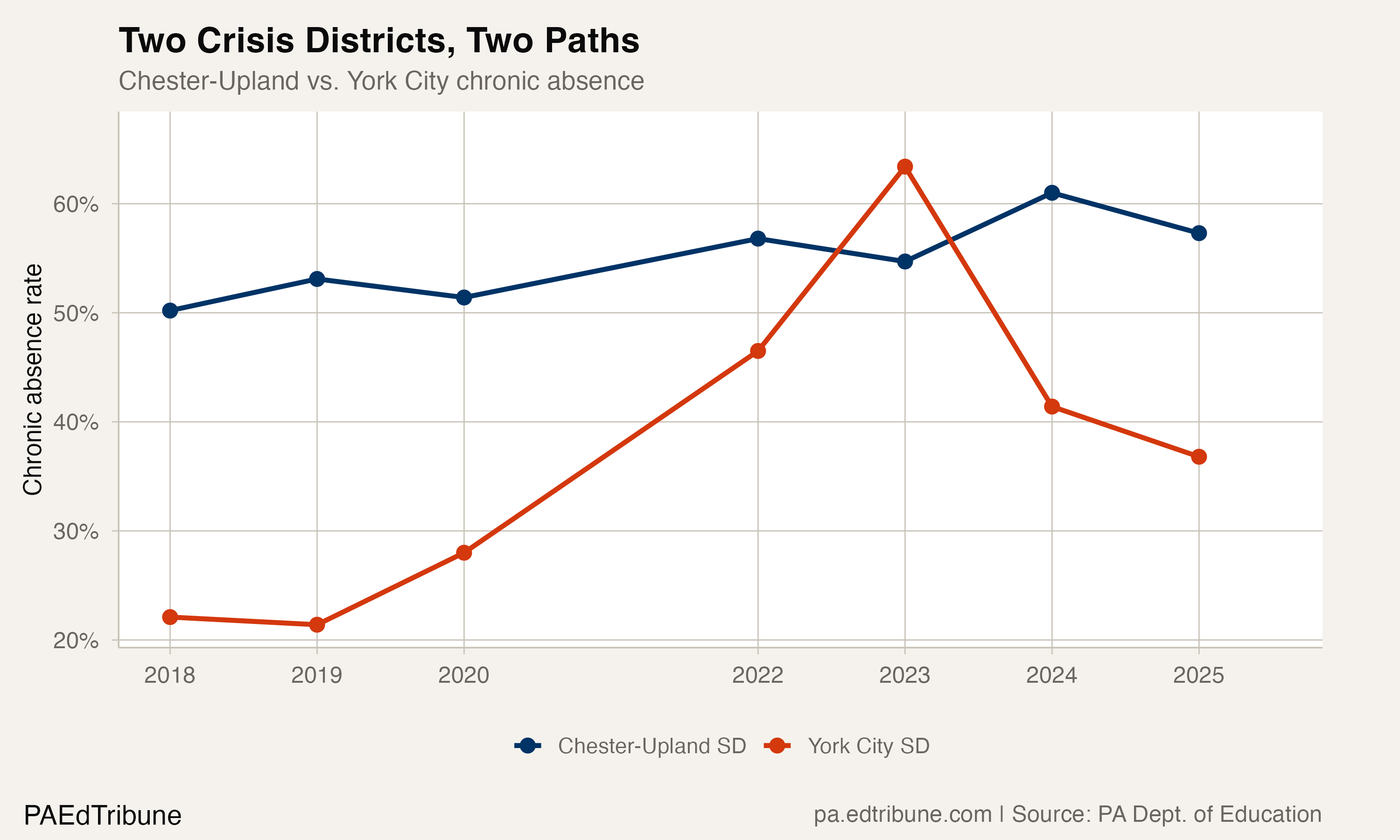
York City↗ET SD started from a similar place. Its chronic absence rate hit 63.4% in 2023, exceeding Chester-Upland's worst mark. But York City has recovered 26.6 points in two years, dropping to 36.8%. The trajectories diverged in 2024: York City fell 22 points while Chester-Upland rose 6.3.
The comparison is imperfect. York City and Chester-Upland face different combinations of poverty, housing instability, and school quality. But it demonstrates that rates in the 50s and 60s are not permanent conditions. York City proved they can change rapidly. Chester-Upland has not.
The charter school factor
Chester-Upland's attendance crisis exists alongside a structural financial crisis driven in part by charter school tuition payments. Nearly half the district's students now attend charter schools, and state law requires the district to pay tuition to those operators from its already-depleted budget. The district has confronted the prospect of an unprecedented charter takeover of its remaining schools.
Whether chronic absence causes families to choose charter alternatives or whether the financial drain of charter payments degrades the district's ability to address attendance is a question the data cannot answer directly. What is visible is that a district spending a substantial share of its revenue on tuition to outside operators has fewer resources for the transportation, counseling, and family outreach that research identifies as effective attendance interventions.
What 50% means in a building
At a 57.3% chronic absence rate, a teacher in Chester-Upland can expect that on any given day, a significant fraction of seats will be empty. Lesson planning assumes continuity. Chronic absence breaks it. A student who misses 18 or more days in a 180-day year (the typical threshold for "chronic") returns to a classroom that has moved on. Multiply that across seven schools and every grade level, and the instructional challenge becomes structural.
Pennsylvania's 2025-26 budget included $111 million for school-based mental health services and safety programs. Whether any of that funding reaches Chester-Upland in a form that addresses the specific barriers keeping its students from attending, housing instability, transportation gaps, poverty, community violence, depends on implementation decisions that have not yet been made public.
Chester-Upland has been in receivership for 14 years. Its chronic absence rate has been above 50% for at least seven. York City, starting from a worse position, recovered 27 points in two years. Chester-Upland has not recovered one.
Detailed code that reproduces the analysis and figures in this article is available exclusively to EdTribune subscribers.
Discussion
Sign in to join the discussion.
Loading comments...