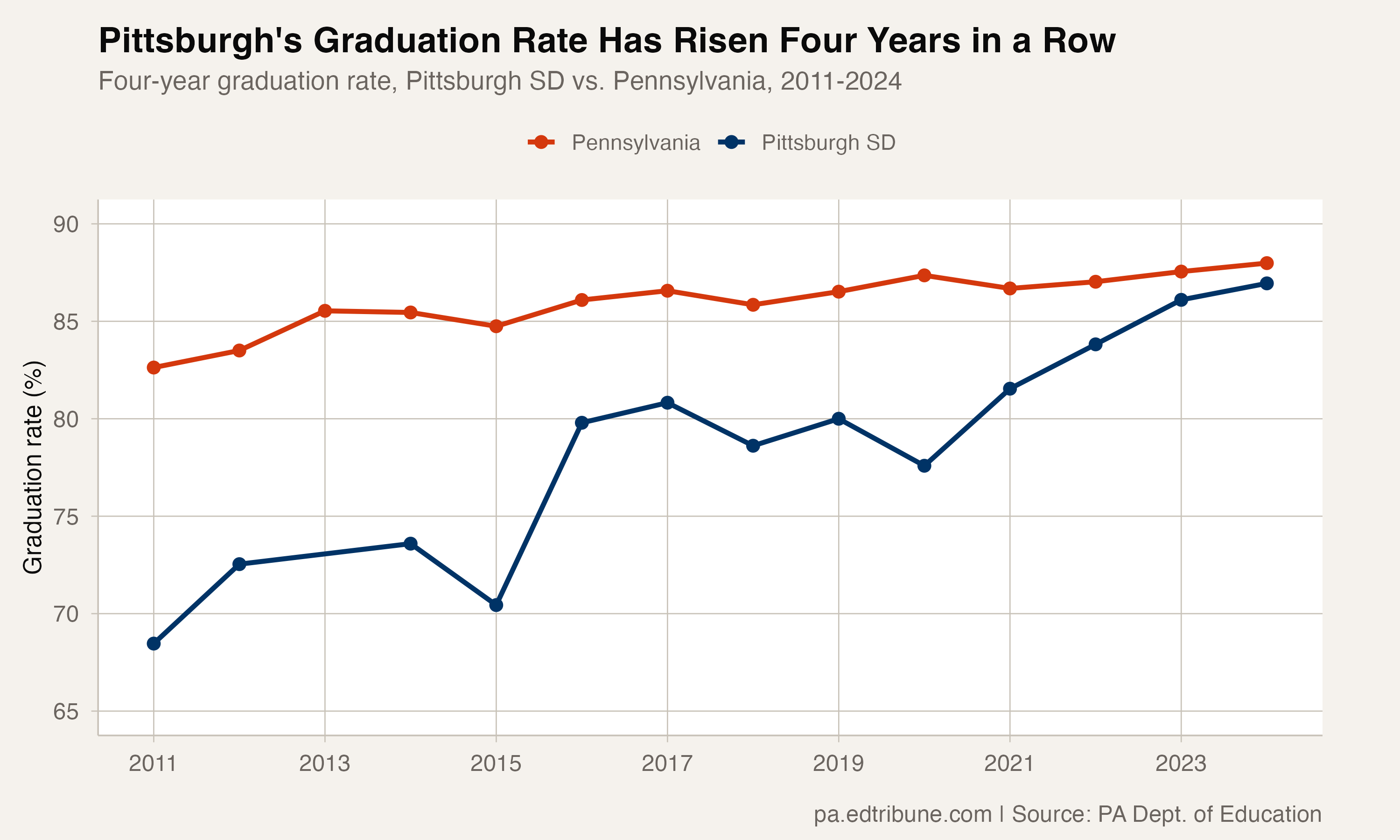
Pittsburgh Public Schools↗ET posted its fourth consecutive year of graduation rate improvement in 2024, reaching 86.9 percent. That was 1.0 point below Pennsylvania's 88.0 percent statewide rate and 18.5 points above where Pittsburgh stood in 2011.
The streak is not dramatic in any single year. The gains were 4.0, 2.3, 2.3, and 0.8 percentage points from 2021 through 2024. But their consistency is what makes them notable. Pittsburgh has not had a down year since the COVID dip of 2020, and the four-year climb is the longest uninterrupted upward run in the district's available graduation data.
The investment
WESA reported in December 2024 that district leaders attributed recent graduation progress partly to high-school counseling investments that reduced Pittsburgh's average student-to-counselor ratio from 699:1 to 350:1. That attribution is suggestive context, not proof that the ratio change caused the graduation-rate gains by itself.
The ratio itself is a documented local change. The American School Counselor Association recommends 250 students per school counselor and says smaller ratios are linked in research to attendance, GPA and graduation outcomes. Pittsburgh's earlier 699:1 ratio was about 2.8 times that benchmark; the newer 350:1 ratio is still above the recommendation but roughly half the previous caseload.
WESA also reported that Pittsburgh administrators were using progress monitoring, structured documentation and mentorship to identify students who needed support. Those are direct evidence of the district's stated strategy, while the causal mechanism remains only suggestive context until district leaders or additional evaluation evidence connect those interventions to the observed graduation gains.
The long arc
The 18.5-point improvement from 2011 to 2024 was not a straight line. Pittsburgh climbed from 68.5 percent to 80.8 percent by 2017, dipped to 78.6 percent in 2018, recovered to 80.0 percent in 2019, then fell again to 77.6 percent during COVID in 2020.
The current four-year streak has been the most sustained upward run in the available data. The 86.9 percent rate in 2024 is the highest graduation rate Pittsburgh has recorded in the state package. In 2011, Pittsburgh ranked in the bottom quarter of Pennsylvania district-level graduation rows; by 2024, it was just 1.0 point from the state average.
The shrinking cohort
Pittsburgh's graduating cohort also shrank over the period, from 1,966 students in 2011 to 1,264 in 2024, a 35.7 percent decline.
The cohort decline is a competing explanation for part of the rate movement. Smaller cohorts can make individual interventions easier to manage, but they also make rates more sensitive to changes in the number of graduates. The graduation data verifies the smaller cohort and the higher rate; it cannot separate how much of the improvement came from counseling, monitoring, cohort composition or other local factors.
Closing the gap
In 2011, Pittsburgh's 68.5 percent rate trailed the state average by 14.2 percentage points. By 2024, that gap had shrunk to 1.0 point.
Philadelphia has shown a larger absolute improvement, rising 21.1 points from 2011 to 2024, but it started from a lower floor and still trailed the state by 11.7 points in 2024. Pittsburgh's claim is narrower: it is much closer to state parity after four consecutive years of gains.
Detailed code that reproduces the analysis and figures in this article is available exclusively to EdTribune subscribers.
Discussion
Sign in to join the discussion.
Loading comments...