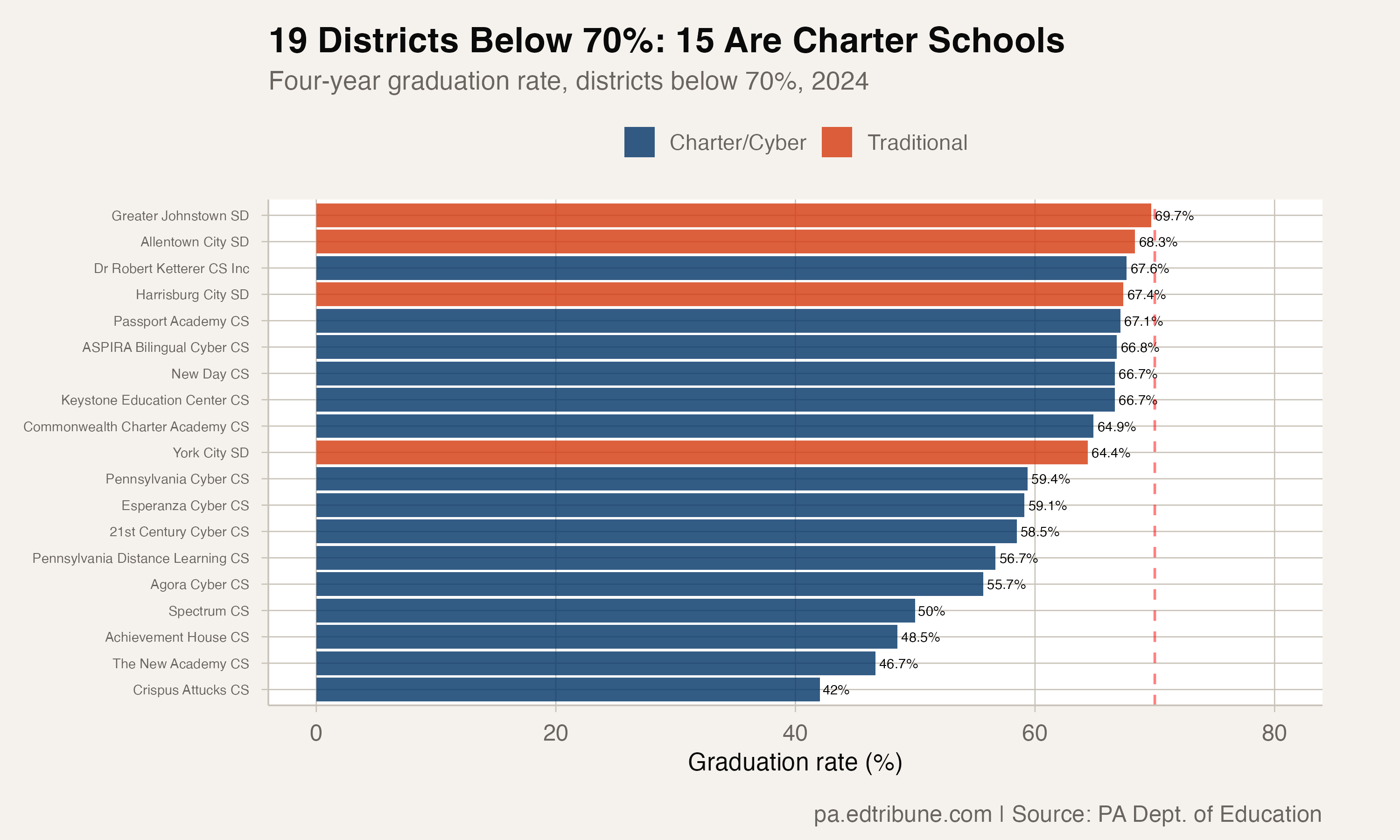
Nineteen districts in Pennsylvania graduated fewer than 70% of their students in 2024. Fifteen of them are charter schools.
That statistic encapsulates a fundamental tension in Pennsylvania education policy: the state's lowest-performing graduation entities are predominantly charter and cyber charter schools that operate under a different accountability framework than the traditional school districts, whose combined 89.6% graduation rate they trail by 28 points.
The list
At the bottom sits Crispus Attucks Charter School at 42.0%. The New Academy Charter School graduated 46.7% of just 15 students. Achievement House Charter School, a cyber charter with a 367-student cohort, graduated 48.5%.
The cyber charter schools cluster in the 55-67% range: Agora Cyber CS at 55.7%, Pennsylvania Distance Learning at 56.7%, 21st Century Cyber at 58.5%, Esperanza Cyber at 59.1%, and Pennsylvania Cyber at 59.4%. Commonwealth Charter Academy, with the largest single cohort of any charter at 3,363 students, graduated 64.9%.
Only four traditional school districts appear on the list: York City SD at 64.4%, Harrisburg City SD at 67.4%, Allentown City SD at 68.3%, and Greater Johnstown SD at 69.7%. Every other entity below the line is a charter or cyber charter school, including Dr. Robert Ketterer Charter School at 67.6%.
The accountability asymmetry
Traditional school districts that persistently graduate below 70% face state intervention. They can be designated for Comprehensive Support and Improvement, which triggers mandatory turnaround planning, external review, and potential reconstitution. These are consequential designations that reshape how a district operates.
Charter schools that persistently graduate below 70% face a theoretically parallel accountability structure but a practically weaker one. Pennsylvania's charter law, enacted in 1997, predates the modern accountability framework, and charter authorization and renewal processes vary by authorizer.
The result is that a traditional district graduating 68% faces more immediate pressure than a cyber charter graduating 48%. Whether this disparity reflects intentional policy design or accumulated legislative inaction, its practical effect is to concentrate accountability on the four traditional districts while leaving the 15 charter entities to continue operating at rates that would be considered emergency-level in the traditional sector.
Who these schools serve
Charter and cyber charter schools at the bottom of the distribution are not randomly selected populations. Many serve students who left or were pushed out of the traditional system: students with chronic attendance problems, behavioral histories, or family circumstances that made traditional schooling untenable.
Achievement House explicitly serves students through a cyber/blended model designed for those who struggled in brick-and-mortar settings. PA Distance Learning serves a similar population. These schools may be serving the students most likely to drop out regardless of institutional setting.
This is the fundamental measurement problem: if these schools did not exist, many of their students would not appear in any district's graduating cohort. Some would have dropped out without being counted. Attributing a 48% graduation rate to the school may be more accurately understood as the school graduating 48% of students who otherwise had a near-zero chance of graduating.
But that interpretation has limits. Commonwealth Charter Academy, with a 3,363-student cohort and a 64.9% rate, is too large to explain entirely as a last-resort option. Some of those students chose cyber school for convenience, flexibility, or family preference, not because they were at imminent risk of dropping out.
The four traditional districts
York City SD at 64.4% represents the lowest-performing traditional school district in the state. Unlike Erie, which declined from above 80%, York City has been below 70% in 9 of the 14 years of available data. Harrisburg at 67.4% has now fallen in three straight years from a 2021 high of 73.9%. Allentown at 68.3% dropped from a 2022 peak of 80.0%, a decline steep enough to suggest that COVID-era accommodations temporarily masked underlying weaknesses. Greater Johnstown at 69.7% sits just below the threshold, a small Rust Belt district whose enrollment has fallen about 6% since 2015.
These four districts had 2,310 students in their 2024 four-year graduation cohorts. The 15 charter schools had 7,177. The charter sector's below-70% cohort is 3.1 times the traditional sector's.
Detailed code that reproduces the analysis and figures in this article is available exclusively to EdTribune subscribers.
Discussion
Sign in to join the discussion.
Loading comments...