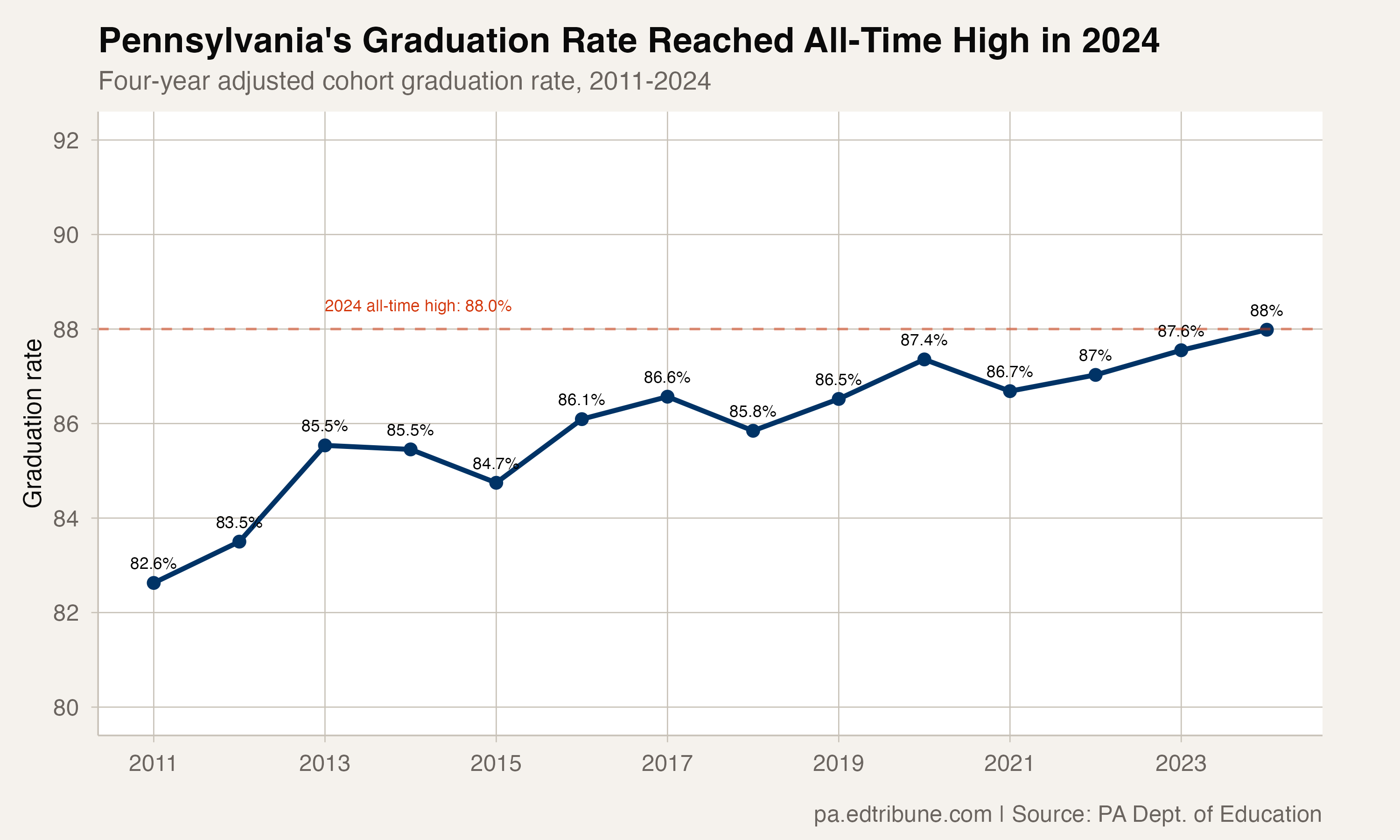
Pennsylvania's four-year graduation rate reached 88.0% in 2024, the highest mark in at least 14 years of available data and a 5.4 percentage point climb from the 82.6% rate recorded in 2011.
The number invites celebration. But it tells an incomplete story.
Over the same period that the rate climbed, the graduating cohort shrank by nearly 16,000 students. In 2011, 153,546 students formed the four-year cohort tracked by the Pennsylvania Department of Education. By 2024, that number had fallen to 137,548, a 10.4% decline. The state is graduating a larger share of a smaller group.
The arithmetic creates a paradox. Pennsylvania produced 121,022 graduates in 2024, down from 126,871 in 2011. The all-time high rate yielded 5,849 fewer actual graduates. For a state wrestling with workforce shortages and an aging population, the raw count matters as much as the percentage.
The steady climb
The improvement was not a sudden jump. Pennsylvania's rate rose in most years, interrupted by occasional dips that never lasted more than one year.
The largest single-year gain came early: a 2.0 percentage point jump from 2012 to 2013, when the rate crossed 85% for the first time. After that, progress slowed to roughly half a point per year. The 2018 dip to 85.8% and the 2021 dip to 86.7% (the only COVID-era regression) both recovered within a year.
Since 2022, the rate has climbed in three consecutive years: 87.0%, 87.6%, 88.0%. That streak coincides with the full implementation of Act 158, which created five pathways to graduation beginning with the class of 2023, including alternatives to the Keystone Exams such as industry certifications and portfolio-based assessments.
The shrinking pipeline
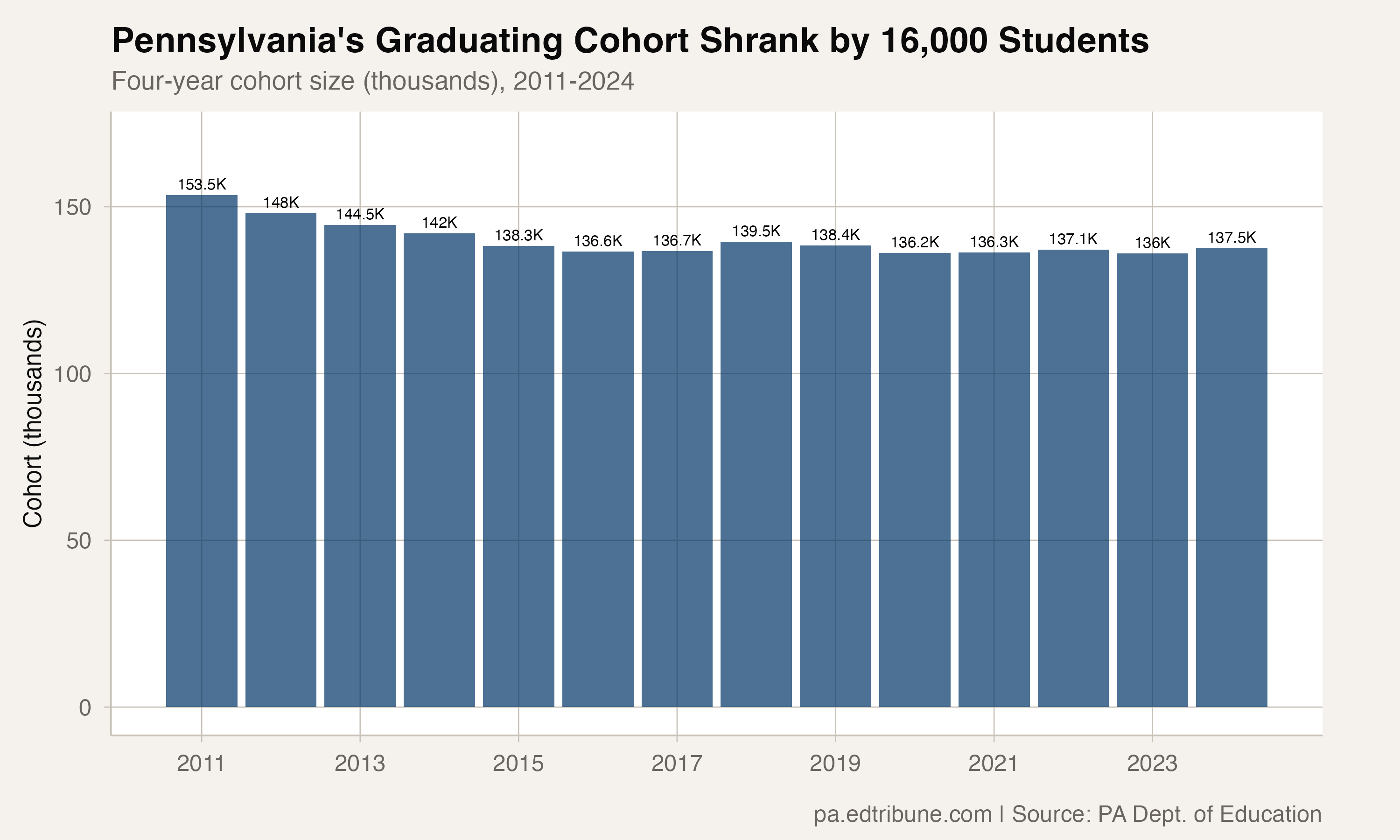
The cohort decline reflects demographic shifts a generation in the making. Pennsylvania's birth rate peaked in the mid-2000s and has fallen steadily since, a pattern visible nationally but pronounced in the Northeast. The pipeline is thinning from the bottom: kindergarten enrollment in the commonwealth has dropped roughly 15% over the past decade.
The shrinkage was not even across groups. The cohort decline hit hardest in Philadelphia, where the graduating cohort fell 41.3%, from 16,099 to 9,446. Rural districts in northern and western Pennsylvania saw similar erosion. Meanwhile, a handful of suburban districts in Chester and Montgomery counties grew their cohorts modestly.
What the numbers obscure
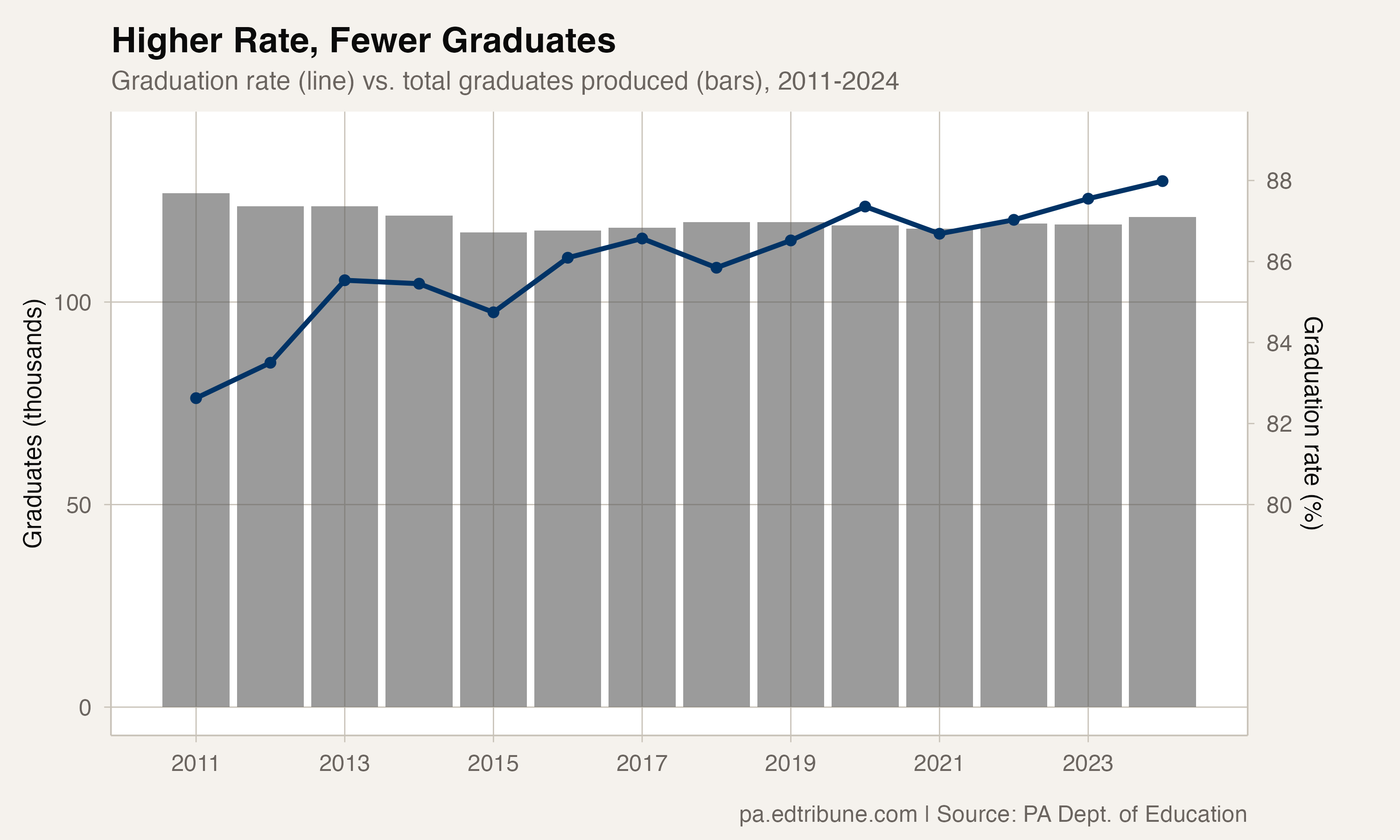
The gap between rate and raw count raises questions that the data alone cannot answer.
Does graduating a higher share of a smaller cohort represent genuine educational improvement? A smaller cohort can mean more attention per student and tighter intervention, with fewer students slipping through. That would be a real gain.
But smaller cohorts also reflect departures: to cyber charter schools (which graduate at 64%), to GED programs, to early workforce entry. Students who leave the cohort before senior year are not counted in the denominator. If the students most likely to struggle are disproportionately leaving, the remaining pool is easier to graduate by default.
Pennsylvania does not publish data on how many students exit the cohort and why, making it impossible to untangle these effects from the headline rate.
Subgroup rates in 2024
The all-time high is broad-based. Asian students lead at 94.2%, followed by white students at 91.6% and female students at 90.1%. Black students graduated at 80.5% and Hispanic students at 78.3%, both dramatically improved from 2011 levels but still trailing the state average by 7 to 10 points.
Special education students graduated at 76.0%, the lowest rate of any major subgroup and virtually unchanged relative to the overall rate since 2017. Economically disadvantaged students hit 82.9%, narrowing their gap with all students to just 5.1 percentage points, down from 11.3 in 2011.
What to watch
Three dynamics will determine whether the rate continues climbing or plateaus near 88%.
First, the Act 158 pathways are still new. If alternative pathways are primarily credentialing students who would have graduated anyway through Keystone Exams, the structural boost will fade. If they are genuinely recovering students who would have dropped out, the impact could compound.
Second, the cohort will continue shrinking. The Pennsylvania Department of Education projects kindergarten enrollment will decline further through at least 2028, meaning smaller graduating classes for at least five more years.
Third, the 12% of students who do not graduate remain disproportionately concentrated in urban districts and cyber charter schools, sectors with distinct challenges and distinct policy levers. Whether the state's rising tide reaches those students will determine whether 88% becomes a floor or a ceiling.
Detailed code that reproduces the analysis and figures in this article is available exclusively to EdTribune subscribers.
Discussion
Sign in to join the discussion.
Loading comments...