Reading and Allentown share a lot on paper. Both are mid-size Pennsylvania cities with majority-Hispanic student populations. Both struggle with concentrated poverty. Both started the decade with Hispanic graduation rates near 60%.
What happened next diverged sharply.
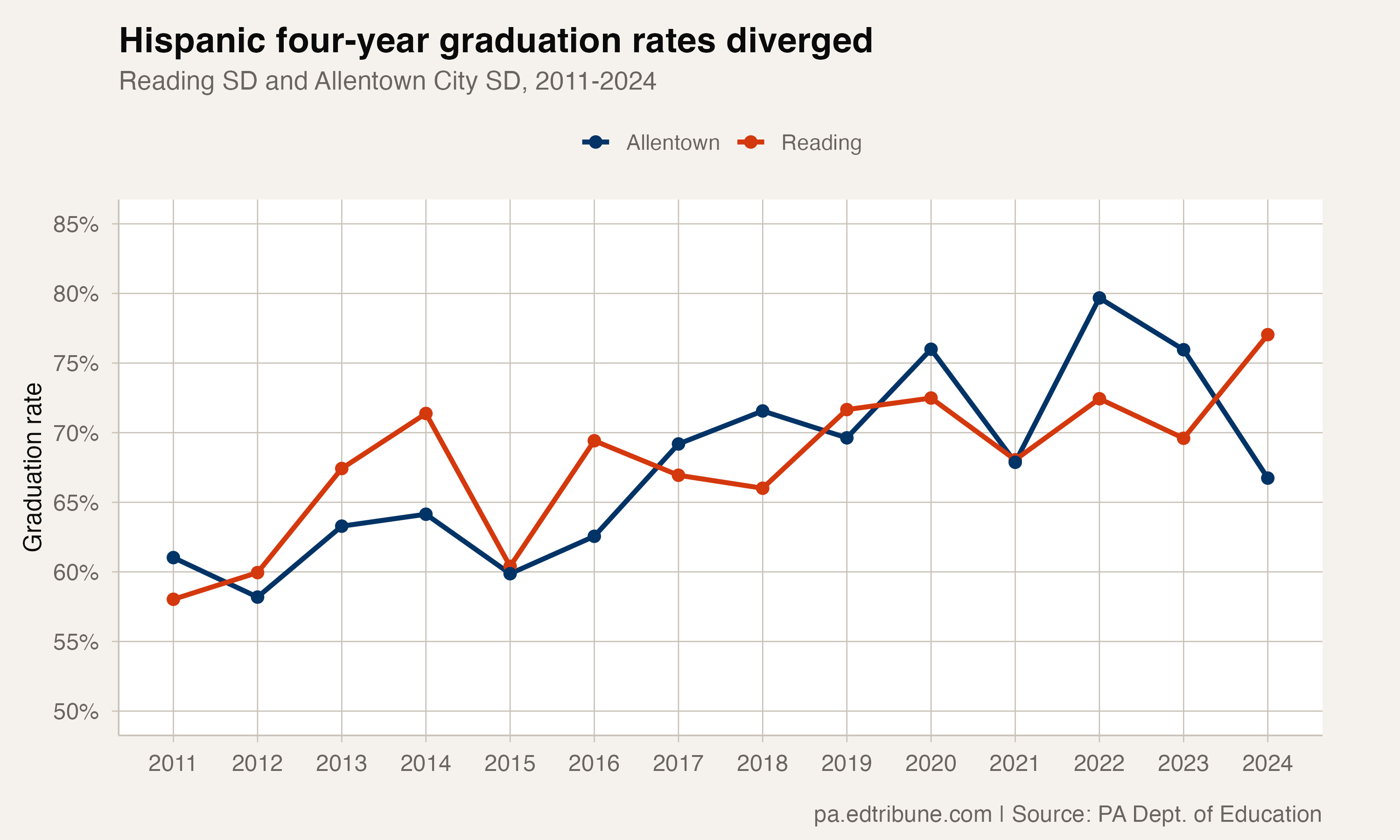
Reading SD's Hispanic graduation rate climbed from 58.0% in 2011 to 77.0% in 2024, a 19 percentage point improvement that leaves the district at the highest Hispanic graduation rate in the 14 years the state has published. Allentown City SD's Hispanic rate sits at 66.7% in 2024, 5.7 points above its 2011 level of 61.0% and 12.9 points below its 2022 peak of 79.7%.
Reading's trajectory
Reading's improvement was volatile. The rate spiked to 71.4% in 2014, dropped back to 60.4% in 2015, and spent most of the late 2010s oscillating between 66% and 72%. The 2024 result breaks that pattern: after slipping to 69.6% in 2023, the rate rose 7.4 points to 77.0%, the highest in the published series. It was the district's third-largest one-year gain, behind 2016 and 2013, but the first one to land at a record.
The district's overall graduation rate, covering all students, moves the same way, climbing from 61.0% in 2011 to 75.5% in 2024. Hispanic students make up 87% of Reading's enrollment, so the two series track each other closely.
Statewide, the white-Hispanic graduation gap stands at 13.3 percentage points. Reading's Hispanic rate of 77.0% is below the statewide Hispanic average of 78.3%, but the distance has closed: the gap between Reading's Hispanic students and that statewide average narrowed from 6.6 points in 2011 to 1.3 points in 2024.
Allentown's reversal
Allentown's path is more troubling. The district's Hispanic rate climbed from 61.0% in 2011 to a peak of 79.7% in 2022, a gain that put Allentown ahead of Reading in six of the 14 years, including 2022 and 2023. Then it fell back.
The rate went from 79.7% in 2022 to 76.0% in 2023 to 66.7% in 2024. That 12.9-point drop in two years erased about two-thirds of the ground Allentown had gained since 2011, and it leaves the district's Hispanic students at their lowest graduation rate since 2016.
The statewide record does not support reading that reversal as a general post-pandemic correction. Pennsylvania's overall graduation rate rose in each of the two years after 2022, reaching 88.0% in 2024, and the statewide Hispanic rate reached a series high of 78.3% in the same year Allentown's fell to 66.7%. Whatever moved Allentown did not move the state.
What separates the two cities
The divergence raises a question without a clean answer: why did Reading's gains stick while Allentown's evaporated?
Both cities serve similar populations. Both have high poverty rates. Both contend with the challenges of educating large numbers of students whose home language is Spanish, including recent immigrants and long-established families.
One difference is timing. Reading reached its highest recorded rate in 2024, gaining 7.4 points in a year when the statewide Hispanic rate rose 1.6 points. Allentown peaked two years earlier, in 2022, and its rate has fallen in each of the two years since.
Another difference is the trajectory shape. Reading improved slowly and unevenly across the full 13 years, with five down years along the way. Allentown rose sharply, peaked, and fell just as sharply. The data shows the two shapes; it does not explain them.
The statewide context
Pennsylvania's Hispanic graduation rate reached 78.3% in 2024, up from 64.6% in 2011. The white-Hispanic gap narrowed from 23.7 to 13.3 percentage points. That progress is real and statewide.
But Allentown and Reading illustrate that statewide trends can mask very different local realities. One city's Hispanic students are graduating at their highest rate ever. The other city's students are at their lowest rate since 2016. The data alone does not explain why.
Graduation-rate and enrollment figures come from the Pennsylvania Department of Education.
Detailed code that reproduces the analysis and figures in this article is available exclusively to EdTribune subscribers.
Discussion
Sign in to join the discussion.
Loading comments...