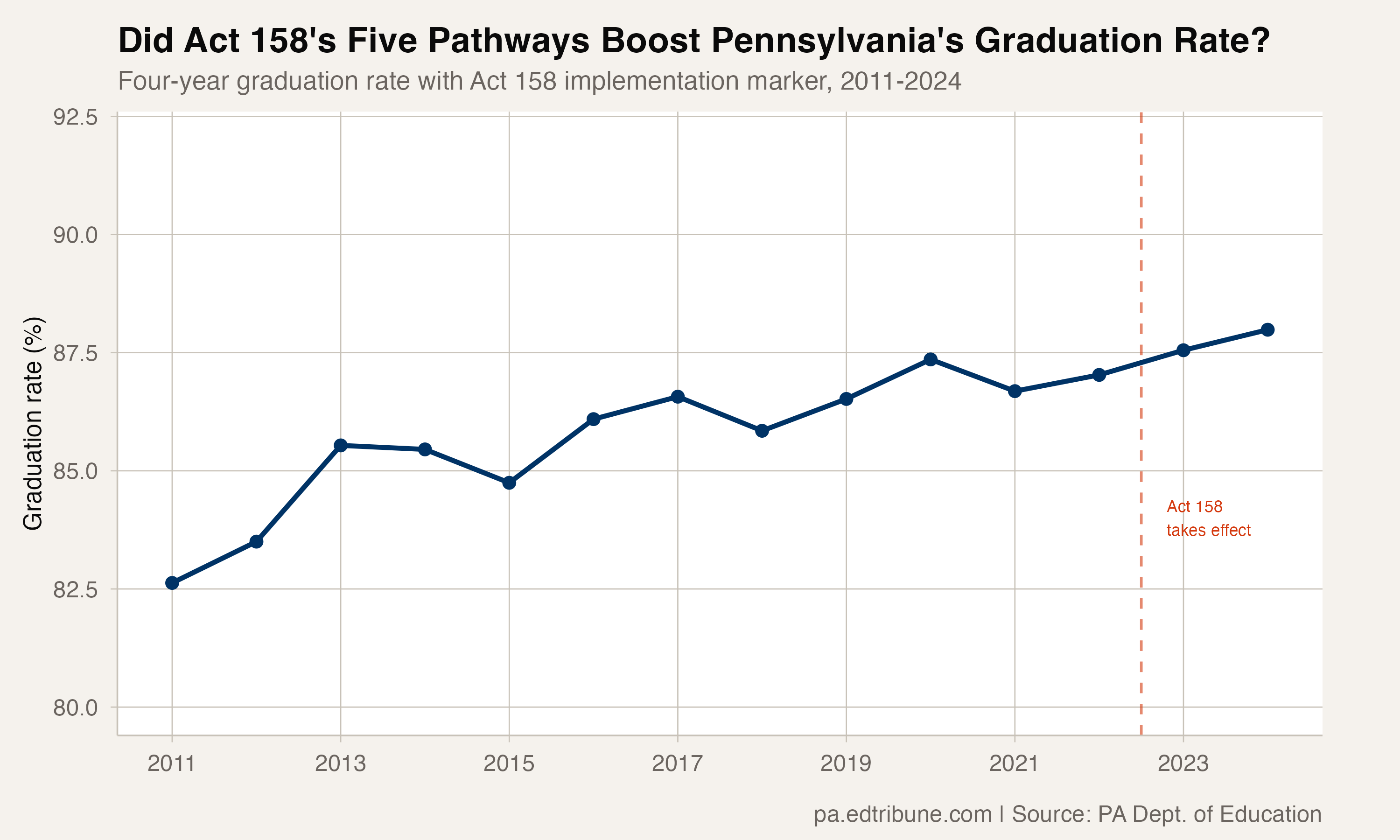
Pennsylvania's graduation rate rose from 87.0% in 2022 to 87.6% in 2023 to 88.0% in 2024, a steady upward tick.
According to the Pennsylvania Department of Education, the full implementation of Act 158 gave students five pathways to graduation beginning with the class of 2023.
The timing is suggestive. Whether it is causal is impossible to determine from available data.
What Act 158 changed
Before Act 158, Pennsylvania students were required to demonstrate proficiency on the Keystone Exams, standardized tests in Algebra I, Biology, and Literature, to receive a diploma. Students who failed the exams could retake them, but the requirement created a hard gate between coursework completion and graduation.
Act 158 created four alternatives:
Keystone Composite: Students who score below proficient on one or two Keystone Exams but meet a combined score threshold can still graduate.
Alternate Assessment: Students with disabilities who cannot take the Keystone Exams demonstrate proficiency through the Pennsylvania Alternate System of Assessment.
Evidence Based: Students compile a portfolio of coursework, projects, and other evidence demonstrating readiness, reviewed by a school team.
CTE Pathway: Students who complete a career and technical education program and earn an industry-recognized certification can substitute that credential for Keystone Exam proficiency.
The fifth pathway is original Keystone Proficiency: scoring at or above the proficient level on all three exams.
The case for an effect
The post-2022 acceleration is faster than the preceding trend. From 2019 to 2022, the rate rose 0.5 points across three years (86.5% to 87.0%), a near-plateau of about 0.2 points a year. From 2022 to 2024, it rose 1.0 point across two years, about 0.5 points a year, roughly three times the earlier pace.
Career and technical education centers, which have an explicit pathway named for their sector, graduated 97.9% of their 2024 cohorts, the highest rate of any sector in the state and 7.9 points above the next highest, charter schools at 90.0%. Students who might have failed a Keystone Exam but earned a welding certification or nursing credential can now graduate through the CTE Pathway.
The Evidence Based Pathway is particularly relevant for students with strong coursework but weak test performance. Without data on how many students used each pathway, the magnitude of the effect is unknown. But the mere existence of alternatives may have changed institutional behavior, since counselors and administrators now have options for students who were previously stuck.
The case against
The 1.0-point improvement from 2022 to 2024 is well within the normal variation of the preceding decade. Pennsylvania's rate rose 2.0 points in a single year (2012 to 2013) and 1.3 points in another (2015 to 2016).
Both increases predate Act 158.
The recent improvement could simply be a continuation of the long-term trend, which has averaged roughly 0.4 points per year since 2011.
The rate also rose during COVID (87.4% in 2020) without any pathway changes, suggesting that year-to-year fluctuations can occur for many reasons.
The diploma question
The deeper concern is what Act 158 means for the value of a Pennsylvania diploma. If students who cannot demonstrate proficiency in algebra, biology, and literature can graduate through alternative pathways, has the diploma become easier to earn without a corresponding increase in learning?
Proponents argue the Keystone Exams were always a blunt instrument (a single test on a single day) and that the alternative pathways better measure genuine readiness through accumulated evidence. A student who completes a CTE program and earns an industry certification has demonstrated real skills, even if standardized test performance is weak.
Critics argue the alternatives create an incentive to route struggling students around academic standards rather than helping them meet those standards. The Evidence Based Pathway, which relies on school-level review rather than external assessment, is particularly susceptible to pressure to pass students through.
What the data cannot tell us
Pennsylvania does not publish pathway-level graduation data. There is no public accounting of how many students graduated through each pathway in 2023 or 2024. Without that information, it is impossible to determine whether the post-Act 158 rate increase was driven by pathway changes, by the same institutional improvements visible before the law, or by demographic shifts in the cohort.
Until the state publishes pathway data, the relationship between Act 158 and graduation rates will remain a matter of timing coincidence rather than demonstrated causation.
Detailed code that reproduces the analysis and figures in this article is available exclusively to EdTribune subscribers.
Discussion
Sign in to join the discussion.
Loading comments...